
EHR Mobile App Development with Offline Access
Discover how Romexsoft helped TherapyBOSS extend clinical workflows through a HIPAA-compliant mobile app with offline access, scheduling, and visit documentation.
Our Customer
Software for Therapists
TherapyBOSS is a healthcare SaaS solution built for therapy providers and home health agencies. The platform services business-critical daily operations for healthcare teams, including patient scheduling, electronic visit documentation, reassessment tracking, referral management, and coordination across care workstreams.
THE CHALLENGE
Bringing EHR Workflows to Clinicians in the Field
TherapyBOSS needed a mobile application that could support EHR-related workflows for specialists working outside office environments. The app had to bring the platform’s essential features to mobile while keeping sensitive information protected and synchronized with server and other mobile devices.
Mobile Access to Clinical Records
Clinicians needed a mobile way to access the platform, and keep care data accurate while working outside the office. Since home visits often took place in areas with unstable internet connection, the application also had to support offline access to clinical procedures.
HIPAA-Compliant ePHI Storage
The application stored ePHI (Electronic Protected Health Information) locally, so patient data had to remain secured on clinicians’ devices. The challenge was to encrypt local records and ensure that each user could access only the information they were authorized to view.
Accurate Synchronization of Clinical Records
Clinical records created or updated offline had to sync correctly once the connection was restored. The application needed to preserve data integrity, prevent data loss, and ensure that updates were not duplicated, distorted, overwritten, or linked to unrelated patient records.
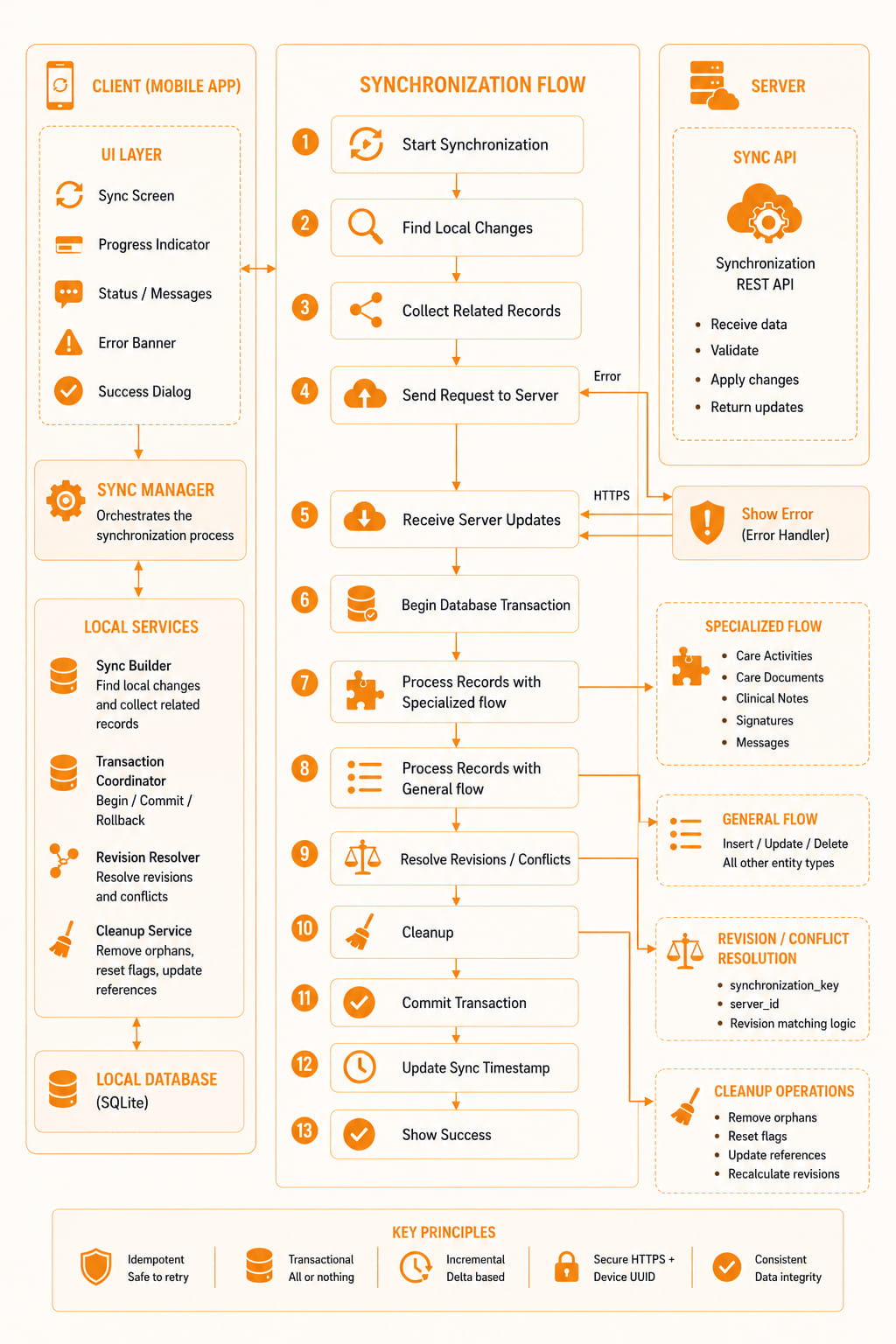
This required synchronization logic that could identify records, track changes, and reconcile updates safely. The synchronization process must be idempotent and preserve data integrity by safely handling duplicate requests. Since a network interruption or lost server response may cause the client to retry the same synchronization, the system must detect and ignore duplicate data or otherwise ensure that repeated processing does not create inconsistent, duplicated, or corrupted records.
Scheduling and Care Coordination
Clinicians needed to manage patient visits inside the application, including scheduled appointments and agenda-based planning. The calendar had to support field workflows where users planned visits, completed documentation, and coordinated care from the same system.
Outdated Mobile Architecture Limiting Product
The first cross-platform version helped validate offline clinical processes, but it became limiting as the product grew. Non-native UI, single-threaded operation, and limited upgrade flexibility made it harder to support a modern mobile experience for app users.
THE SOLUTION
EHR Mobile App Development
To support users during home visits, our team approached the mobile application as an extension of the core healthcare web application. The work started with an offline-capable MVP and later evolved into a native iOS application as the product’s mobile requirements grew. The focus was on making patient data and clinical documentation usable in real field conditions, where connectivity, data security, and synchronization reliability affected daily operations.
Mobile EHR Features
With the technical foundation in place, we brought key EHR capabilities into the mobile experience.
Visit Management
To support appointment management, our team implemented RRule from the iCalendar protocol. A comprehensive scheduling system allows therapists to view, create, modify, and confirm appointments. Users can also schedule time off, receive reminders, monitor specialists schedules, and synchronize appointments with personal or work calendars for daily planning.Route Planning and Navigation
For clinicians performing multiple daily visits, the app provides intelligent route optimization and quick access to patient locations. Patient addresses can be opened directly in navigation apps, reducing travel time and improving scheduling efficiency.Patient Management
It allows users to access assigned patient records directly from their mobile device. Patient demographics, referral information, attached documents, care history, assigned clinicians, and other clinical information are available to support treatment during patient visits.Clinical Documentation
Mobile application enables therapists to complete clinical documentation. It includes compliant note templates, care-plan-driven documentation, automatic data population, clinical validations, prior note history, and workflow optimizations that significantly reduce documentation time while maintaining regulatory compliance.Electronic Visit Verification (EVV)
Our team also implements EVV functionality that enables clinicians to electronically verify that patient visits occur at the correct time and location. Based on the office configuration, mobile application automatically records visit start and end times and captures location information, helping organizations comply with federal and state EVV requirements.Communication and Notifications
Also mobile software provides alerts, reminders, notifications, and communication capabilities that help users stay informed about schedule changes, required documentation, unsigned notes, pending tasks, and other important workflow events requiring attention.
Mobile Extension of the EHR Platform
The first version was built as an MVP to test whether users could manage clinical work processes without a constant internet connection. For the initial implementation, our specialists used Adobe AIR, which matched the team’s experience and the product context at the time. This allowed TherapyBOSS to launch a cross-platform mobile application for both Android and iOS.
Offline Access to Clinical Records
We enabled local data storage using SQLite. After the first login, the application loads the required information to the local system, so end users can continue working even when the server connection is unavailable.
Using locally stored data, patient information, schedules, documentation, and other work can be accessed and completed offline, with all changes synchronized automatically once a connection becomes available. This enables uninterrupted work during home visits or in locations with unreliable connection.
Encrypted Local ePHI Storage and Authorized Access
To keep locally stored patient data protected, our team used SQLite encrypted mod, so user information cannot be accessed outside the application.
It also controls which records are loaded from the server. Each user can only access the patient data they are authorized to work with, such as records for patients they are currently treating.
Beyond local encryption, the app followed broader HIPAA-driven security logic, including controlled access to electronic health information, user authentication, data transmission, audit controls, and additional backup.
Validated Synchronization for Clinical Data
To synchronize locally added data, our engineers added validation logic to the synchronization algorithm. This logic prevents records from being synced with patients who are not related to the current user.
Once the software reconnects to the server, offline updates can be aligned while keeping clinical records accurate and properly assigned.
Record Identification and Conflict Resolution
To handle clinical records created or updated from different devices, the team changed how records are identified and integrated.
We replaced a standard ID with a synchronization_key to uniquely identify records. The application also uses last_updated_on to synchronize only records modified after the previous sync.
Native Mobile App Development
The cross-platform solution served the MVP stage but became limiting as the product grew. Its non-native interface, single-threaded operation, and limited upgrade flexibility made it difficult to deliver the performance and user experience clinicians expected.
To overcome these limitations, Romexsoft moved TherapyBOSS toward platform-specific mobile development, starting with iOS. The native iOS app provides a redesigned interface and user-focused capabilities, including optimized map routes for visit planning and iCloud calendar integration. A native Android application is currently being developed with Kotlin and Jetpack Compose. It will include efficient offline data handling through local storage, and smooth loading for large patient and schedule lists.
By working directly with each platform’s SDK, rendering engine, and multithreading capabilities, the native apps can deliver smoother interactions, greater responsiveness, and more platform-specific experiences.
iOS Development Stack
- Swift
- Fastlane
- Cocoapods
- SQLCipher
- GRDBCipher
- KeychainAccess
- SwiftDate
- CryptoSwift
- Moya
- PMJSON
- MTLLinkLabel
- SwipeCellKit
- ProcedureKit
Android Development Stack
- Gradle
- Kotlin
- Coroutines
- Dagger Hilt
- AndroidX Hilt Integration
- Coil
- OkHttp3
- Retrofit2
- Jetpack Compose
- AndroidX Biometric
- AndroidX Paging
- AndroidX Room
How the Offline EHR Mobile App Works
THE RESULTS
From Offline MVP to Native Clinical Mobile App
As a result, TherapyBOSS gained a mobile experience that made patient-related processes more accessible and reliable across clinical use cases.
- EHR-related tools became available on mobile, including treatment documentation, visit schedules, patient data access, calendar-based patient lookup, quick address viewing, route mapping, and direct patient calling
- Clinical users could continue working without constant internet access, supported by the offline-capable MVP
- Patient records remained available on the device and could be updated after reconnection through local data storage and synchronization logic
- The later native iOS application improved mobile usability with a modern interface, optimized map routes for visit planning, and iCloud calendar support.
WHY ROMEXSOFT
Trusted EHR Mobile App Developer
Romexsoft is a healthcare software development company specializing in building, modernizing, and maintaining AWS-based applications across EHR/EMR, telehealth, and remote patient monitoring workflows. We help medical businesses expand their products into mobile environments where users need secure access, usability, and consistent performance.
As an EHR mobile app development partner, we provide:
- Full-cycle EHR/EMR platform design and development, including custom modules for charting, scheduling, e-prescribing, and clinical decision support
- Legacy EHR mobile modernization for outdated or limiting mobile solutions
- API development and healthcare integrations with EHRs, labs, pharmacies, payers, and care systems
- Clinical workflow engineering for documentation, patient data access, and care coordination
- HIPAA-driven security design for sensitive patient data, access control, and compliant healthcare workflows
- Offline data synchronization between mobile devices and central EHR systems, with automatic conflict resolution.
Frequently Asked Questions
What is Electronic Visit Verification (EVV) and why do home health agencies need it?
Electronic Visit Verification confirms that a visit actually happened at the correct time and location. The system records visit start and end times along with location data, creating a verifiable record for each patient encounter. Home health agencies need EVV to comply with federal and state requirements, and to document care delivery accurately for billing and audit purposes. In the TherapyBOSS mobile app, EVV runs automatically based on office configuration, so clinicians don't need to manage verification manually during a visit.
What HIPAA requirements apply specifically to offline-capable healthcare apps?
Offline-capable apps store patient data directly on the device, which raises the stakes for local security. The TherapyBOSS mobile app addresses this through several layers:
- encrypted local storage using SQLite's encrypted mode, so data stays protected even if a device is lost or accessed outside the app
- user authentication
- encrypted data transmission during sync
- audit controls.
Together, these ensure that data leaving the server and living temporarily on a user's device meets the same protection standard as data on the server itself.
How long does it typically take to migrate a cross-platform healthcare app to native?
Migration timelines depend on app complexity, the number of features involved, and how much existing business logic can be reused. For a cross-platform healthcare app like TherapyBOSS, migrating to separate native codebases for iOS and Android typically takes 6-8 months for both platforms, assuming a small dedicated team building them in parallel.
How does the app keep clinical data accurate when multiple devices sync offline changes?
The app identifies records using a synchronization_key instead of a standard ID, which allows records created or modified on different devices to be matched correctly during sync. It also tracks a last_updated_on value, so only records changed since the previous sync get processed, preventing older data from overwriting newer updates.
Validation logic checks that records only sync with patients actually related to the current user, and the sync process is idempotent – if a network interruption causes a retry, the system detects and ignores duplicate requests rather than creating duplicate or corrupted records.