How to Run an Application Modernization Assessment for Legacy Software
Initial steps matter the most, so if you’re contemplating digital transformation and legacy system modernization, understanding the meaning and their essence related specifically to your organization is essential. Read about the fundamentals of legacy application modernization assessment, and gain insights on how to implement the practical suggestions to take full advantage of your system review.

Table of Contents
Since there is no one way to approach app modernization because each organization’s culture and each application’s architecture are different, modernization readiness assessment is intended to diagnose the current conditions of the legacy apps and their legacy application modernization steps. When assessing its infrastructure’s functionality, a company aims to reach a revealing analysis of the target app along with its compute, storage and network environment. It provides a profound understanding of the current state of the infrastructure, as well as how it could support your legacy apps after modernization, and is to be further converted into modernization strategy and roadmap.
At the start, all current systems need to be examined so as to functional, business and financial criteria, apart from the technical one. Weighing up these factors within the assessment portfolio, a company can make decisions on which infrastructures are to be prospectively modernized, which digital transformation strategies are relevant to each app, which focus is to be kept within the preferred modernization approach, etc. With special attention devoted to an evaluation of the modernized-to-be infrastructures, a company develops and implements technical solutions for the system transformation according to the strategic planning outlined within the roadmap.
Table of Contents
Expected Business Outcomes from Legacy System Assessment
App modernization readiness assessment may seem complicated and resource-consuming, but it is well worth undertaking if you consider what organizations gain after assessment completion. Here are listed some of the benefits an organization is likely to achieve after conducting app modernization readiness assessment:
- a report: to thoroughly detail the state of existing applications;
- a strategy: to back up each move of the upcoming apps’ modernization;
- a roadmap: to define modernizing from the business perspective, i.e. benefits and risks assessment;
- a blueprint: to describe the architecture of the given app after modernization from the technical side;
- an action plan: to bridge the gaps between the starting moment and the desired point, as well as prevent the probable troubles which can hinder the operation process.
Having conducted an application modernization assessment, an organization may proceed to draft a roadmap for the digital transformation of the selected apps. It will encompass the necessary issues to be taken into consideration, such as:
- business benefits
- risk factors
- dependencies
- further recommendations.
Reasons to Conduct Legacy Application Modernization Assessment
Talking about modernization mainly makes sense in the context of legacy apps. Being key to business functioning while operating on outdated technology, legacy application raises questions and doubts about its future, especially considering the costly maintenance which may not always seem sensible.
As implied previously, multiple decisions on modernization are made foremostly on functional and business grounds. The functional factors encompass the technical software points that are suitable for the app’s maintenance while the business factors embrace the management and commercial reasoning. Any company runs the risk of producing an off-target assessment if they do not conduct a rigorous, detailed, and many-sided analysis. Smooth and effective application modernization is pre-conditioned by a review of many criteria within technical, economic, and institutional points of view before making any decisions.
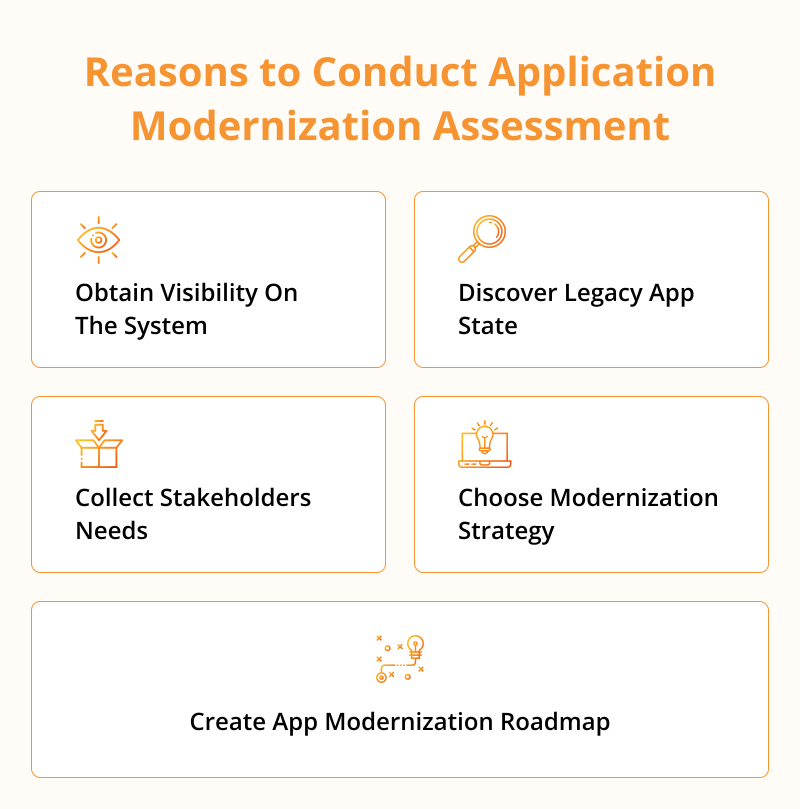
Given that digital transformation is a demanding process, many businesses question the commercial and other practicality of ever-pertinent modernization. If you are still wondering whether your app needs modernization, check out the most common benefits of modernizing legacy systems that we have outlined below.
Obtain General Visibility on the System
This item on the list is absolutely necessary for an organization’s image of a reliable, efficient, secure, and up-to-date website or app. An all-inclusive understanding of the company’s devices, services and infrastructures stands for getting an advantage in ensuring security posture, high performance, cost-efficiency and upcoming improvements. The visibility encompasses:
- how many apps all in all an organization owns;
- what apps are mission-critical for the enterprise;
- how many customer-facing applications a company has;
- whether the pace of the development process is satisfactory.
Collect Stakeholders Needs
Various stakeholders and their groups may put different concerns on their agenda. However, when determining the future of certain legacy apps, the expectations of the stakeholders should be recognized and aligned. With the primary aim of either settling on or refusing from modernization, we strongly advise organizations to select the key stakeholders and put the finger on their drivers and needs.
Another aspect that benefits from interviewing stakeholders is a vision of which apps from the portfolio of a company’s assets are quite up-to-date, and which ones might require some modernization, as well as the rationale to back it up. As the time, financial and other resources are finite, the key stakeholders’ standpoints aid in prioritizing systems for app modernization assessment, and the resource distribution and allocation, according to the defined business objectives.
Technological aspirations reinforced by the most prominent business needs can set the direction and pace for modernization, and generate its strategy which will explain and support decisions and steps taken within the modernization practical roadmap.
Discover Legacy App State
The ongoing condition of legacy systems can be diagnosed through check-ups in these sectors: app performance, security, reliability and cost optimization opportunities which are covered in more detail below.
Performance
The cloud assessment conducted on a company’s systems provides insights into if the app’s performance is fast enough. As a valid metric, App Performance reveals the true condition of every integral part of the infrastructure. Taking into account that cloud applications are an exemption because of their smooth and swift operation, as a rule, legacy applications do not deliver the expected level of performance set by cloud environments.
To illustrate, the performance of websites which don’t fulfill page load speed demands can be a disappointing experience to those users who are already familiar with the faster and more effective performance of cloud-based solutions.
Even though every system is unique in its metric and requirements, for customer-facing web applications, having a competitive advantage of enhanced performance, especially in such tangible factors as operation speed, is always sensible.
There are some online tools that can help you test out your website performance, for instance GTmetrix or PageSpeed Insights.
Security
As one of the present-day central concerns among users and businesses alike, security poses certain challenges and requirements in order to keep up a company’s reputation and competitive standing. A modernization assessment sheds light on whether your infrastructure meets security and compliance requirements. More precisely, you will find out whether…
- there are any security risks that can be avoided;
- auditing and governance processes are set up correctly;
- workload/operation behavior is tracked and monitored;
- applications undergo regular testing and validation.
Cost Optimization Opportunities
Organizations put efforts into striking a balance between maximizing business value and minimizing operation-related expenses. The assessment also pays off by highlighting possible cost optimization opportunities to be employed. What’s more, it goes hand in hand with discovering if a company can simplify…
- manual work performed by its employees;
- customer interactions to boost usability.
Reliability
As one of the paramount parameters determining an app’s viability, reliability serves as a usual target for improvement in a seemingly perfectly-operating system. Aiming at failure-free functioning to fulfil the users’ needs, you will benefit from application modernization assessment so as to find out if the disaster recovery plans and backup procedures are in order. Modernization assessment is intended to identify the effectively operating apps along with the non-effectively functioning ones so that the upgrading strategies can be drafted. Full awareness of the system’s functions can be achieved with the use of the most progressive proprietary tools. In addition, they are handy for risk prevention during and after modernization.
The easiest way for organizations to arrive at a better app performance, while at the same time minimizing the cost to upgrade and maintain their infrastructure, is by preserving core functional applicable code and removing the unnecessary code. One way to pinpoint the former and the latter is by conducting a thorough legacy system assessment; it will also help establish the guidelines suitable for overall environment optimization.
As mentioned before, there is no universal approach for app improvement or modernization, because they will be led by a set of your specific business drivers, objectives, and infrastructure’s current state. Only a comprehensive evaluation of your systems from both functional and business perspectives will enable you to develop an adequate and viable modernization strategy and an action plan.
How We Conduct Application Modernization Readiness Assessment
Bringing your software to a fundamentally new level of service quality necessarily entails the prior conducting of assessment. This is a key stage in your legacy application modernization. Profoundly carried out research provides executives with all types of hands-on information, including strengths and weaknesses, risks and improvement possibilities that ultimately are put into quite specific and applicable recommendations.
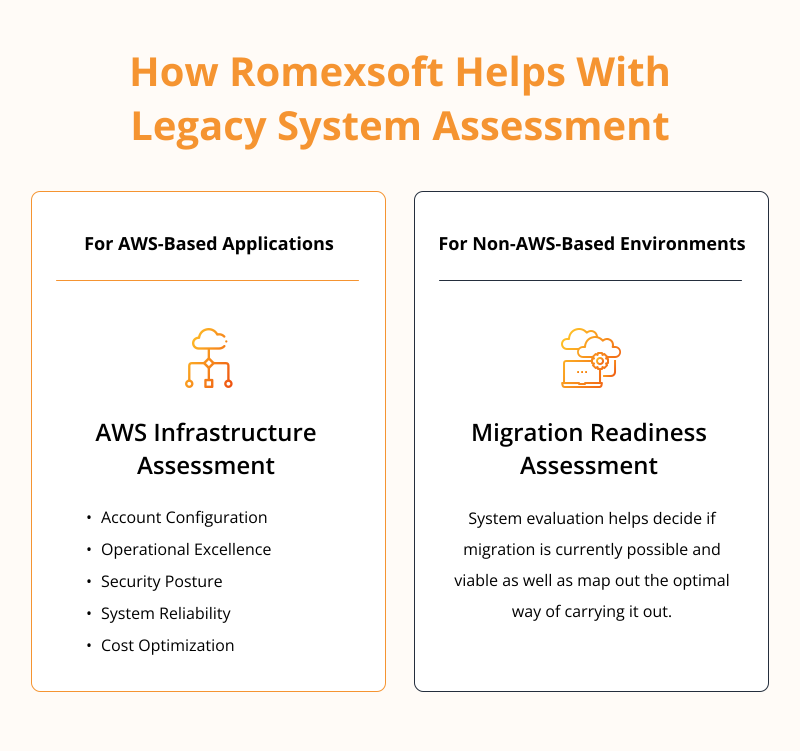
Romexsoft experts are engaged in two major areas of application assessment:
Environment assessment, which focuses on soft- as well as hardware regarding the system’s performance, interoperability, operational expenditure, reliability and failure rate among others.
Application/software assessment proper, which analyses quantitative data so as to user interfaces, change requests or information volumes, and is tied up to the scaffolding elements of apps, such as programming language, test data or CM.
AWS-based systems can benefit from the following offers:
AWS Infrastructure Assessment
As an Advanced APN Partner, we operate in line with AWS Well-Architected Framework, and so conduct the assessments according to the patterns and practices designed by Amazon. Directly contacting AWS Solutions Architects, we ensure Amazon-validated assessment.
Service artefacts: an assessment document, conducted on the basis of the Pillars of AWS Well-Architected Framework. The document encompasses an outline as well as details on infrastructure assessment, complemented by a record of suggested enhancement action items.
AWS infrastructure assessment services comprise:
AWS Account Configuration Assessment
A thorough overview of AWS account resources configuration reveals the former and the present-day AWS resources associations and configurations to track down their evolution.
Operational Excellence Assessment
A review centers around the ability of Romexsoft and its customers to manage and supervise AWS systems for the purpose of enhancing operational processes to deliver business value.
Operational Excellence Assessment encompasses:
- definition of metrics that will evaluate the workload’s health;
- collection and analysis of workload health metrics;
- operational enablement of the personnel to maintain the solution in running, monitoring, recovering and upgrading it;
- deployment testing and validation;
- version-controlled code assets (application code, deployment scripts, or infrastructure templates);
- application and workload telemetry.
Security Assessment
Security assessment covers:
- Identity and Access Management (IAM)
Assessment of IAM is based on the established best practices of AWS and other identity and access management systems acquired by Romexsoft. - Networking
The review requirements include the security best practices for Virtual Private Cloud (Amazon VPC) as well as other network security considerations. - IT Operations
Conditions at the core of this category are derived from IT security operations best practices, namely monitoring, incident response, and data classification.
Reliability Assessment
The criterion, which is rooted in meeting business and customer demand, focuses on the ability of a workload or a system to prevent threats and recover from failures with as little damage as possible. It relates to:
- deployment automation;
- definition of the solution’s recovery requirements, like recovery time objective (RTO) and recovery point objective (RPO);
- solutions’ adaptation to fluctuating demand that can be automated through different AWS services (e.g. Amazon S3, AWS Auto Scaling, etc.) if architecture or licensing limitations permit.
Cost Optimization Assessment
A review of Cost Optimization is grounded in the needs of Romexsoft customers to deliver value in the most cost-efficient way. We perform a total cost of ownership, as well as other cost modelling analyses to render the most comprehensive insights on the running cost for the AWS-based solutions in the customer’s environment.
For non-AWS-based environments, Romexsoft offers and provides:
Migration Readiness Assessment
As a step towards ensuring your business’s continuity and viability among the changing variables of technological and market conditions, AWS migration is associated with more than prospectively increased revenue.
Research carried out for our blog article about application migration to AWS indicates that migrating legacy infrastructures to the cloud is directly linked to the system’s agility, security, resilience and resource distribution, which encourages further technological growth.
For this reason, we aid legacy systems in conducting thorough evaluations of their environments to first decide on whether or not migration is a valid option for the given conditions, and then, map out the optimal way of commencing and completing it.
What Comes After App Modernization Assessment?
After the assessment, the teams move from analysis to execution. Architects and engineering leaders use the assessment results to define an application modernization strategy that aligns business goals with technical realities. The strategy defines how each legacy application should evolve in the cloud and which modernization approach delivers measurable value.
Based on the assessment data, organizations typically choose between approaches such as:
- refactoring applications to serverless AWS architectures;
- containerizing workloads to improve scalability;
- and fault tolerance, or gradually decomposing monolithic systems into microservices using API-centric and event-driven designs.
The path chosen depends on the performance requirements, security posture, cost goals, and operational maturity identified during the assessment.
Then, modernization strategy is then translated into a practical application modernization roadmap. It defines the sequence of modernization activities, balancing business priorities, stakeholder expectations, existing IT assets, available resources, and implementation timelines. It provides a clear, step-by-step plan for executing the modernization while minimizing operational risks and disruptions to ongoing business activities.
If questions or uncertainties arise,we can help you validate decisions, refine the roadmap, and reduce delivery risk as an experienced application modernization vendor.

Frequently Asked Questions
Legacy systems often come with high maintenance costs because aging technologies require more effort to support and fix. They usually have limited scalability, which makes it difficult to handle business growth or fluctuating workloads. Security and compliance become harder to maintain as outdated components are more difficult to patch, monitor, and audit.
Change and release cycles tend to be slow due to tightly coupled architectures, which delays the delivery of new features. Integration with modern platforms and APIs is often limited, reducing flexibility. Reliability can also suffer, with higher failure risk and longer recovery times. In addition, organisations may depend on a small pool of specialists with legacy skills, increasing operational risk.
Supporting legacy systems during the modernization begins with a thorough assessment of your legacy systems to understand their current state. From there, you can identify which components are critical to business operations and must be maintained throughout the modernization process. This information helps you develop a modernization strategy that ensures these critical components are modernized without disrupting business operations. It is especially useful during legacy system modernization, where gradual transition strategies are often necessary. For example, you might choose to modernize these components incrementally, or use a hybrid approach that allows the legacy system and the modernized system to operate in parallel.
Access typically covers application code repositories, infrastructure or cloud accounts, system configurations, logs, and monitoring data. Reviewing CI/CD pipelines, deployment scripts, and existing architecture helps confirm how the system is built and operated in practice. Discussions with engineers, operations teams, and product owners are also important to surface undocumented dependencies and operational constraints.
The assessment does not require write access to production or any disruptive changes. The goal is accurate visibility into the current state while keeping the environment stable and secure.
When legacy systems are undocumented or poorly maintained, start by rebuilding visibility into how the system actually works before making any modernization decisions. This means reviewing the running system, mapping dependencies, and identifying operational and security risks. We can help by assessing your environment, clarifying the current state, and providing practical guidance on safe next steps for modernization.