Application Modernization Strategies for Legacy Systems
Effective application modernisation starts with business and operational priorities. In this article, we explore how to evaluate legacy applications, select practical modernization strategies, and eliminate the emerging obstacles. By reading it, you gain a clear modernization vision that will support your software growth without increasing operational complexity.


Table of Contents
If you feel like your current systems are not giving you an advantage anymore, or that the legacy applications you are working with are starting to require more and more maintenance in order to interact with modern apps, it may be the time to consider Application Modernization for your business.
A study by Grand View Research highlights application modernization as a key factor in the transformation of legacy systems across various industries. In IT and telecommunications, organizations are modernizing existing applications to support technologies such as 5G, IoT, AI, and edge computing without completely reprogramming them. In the public sector, application modernization focuses on updating legacy systems, automating processes, and improving service delivery. These trends position the modernization of legacy systems as a practical foundation for scalability, efficiency, and long-term digital growth.
In this article, we share our experience with modernization to explain how to approach application modernization correctly and share our strategies.
Table of Contents
What is Application Modernization?
Application modernization is a process of updating old applications and platforms to make them fast, reliable, and profitable yet again. It is a natural way of introducing innovation, adopting new technologies, and staying competitive.
Many companies tend to maintain their software systems and applications for years. Usually, this approach works out fine while it allows users to keep their subscriptions to the said systems, which is, in turn, beneficial for business. However, such platforms can become hard to maintain. Your developers start to spend more time on maintenance than on productive updates, or when the cost of maintenance outgrows the cost of replacing the software all together. These systems are called legacy; their usage doesn’t bring any benefits to the users, and causes profit losses.
Why Modernize Legacy Apps and Platforms They are Run On?
You need to consider the application modernization to remain competitive and improve performance by delivering a better customer experience in a cost-effective way. For companies that haven’t been ‘born digital’, overhauling their outdated software can sometimes be the key to staying competitive in the modern market.
Improve Business Agility
Modernized applications enable faster delivery of new features, smoother user experiences, and better alignment with customer expectations. This results in reduced time-to-market, improved service quality, and stronger customer retention. By optimizing infrastructure and development workflows, companies also gain better control over IT costs and unlock new revenue opportunities.
Increase Organizational Efficiency
Legacy systems often require manual processes, fragmented workflows, and constant firefighting. Modernization simplifies operations by introducing standardized environments, automated pipelines, and clearer ownership models. Teams work more efficiently, SLAs become easier to meet, and release cycles shorten, allowing the business to respond faster to change.
Reduce Technical Debt and Operational Risk
Over time, legacy applications accumulate technical debt that makes changes risky and expensive. Modernization helps remove architectural bottlenecks, outdated dependencies, and unsupported components. This leads to more stable systems, easier maintenance, and lower long-term support costs.
Enable New Technologies and DevOps Practices
Modern platforms support cloud-native services, microservices, CI/CD pipelines, and infrastructure automation. This allows organizations to introduce DevOps practices, improve software delivery lifecycle (SDLC), and adopt new technologies without disrupting core business operations. The result is faster innovation with fewer production incidents.
Questions to Ask When Planning an Application Modernization
Before starting an application modernization initiative, it is important to assess the current state of the application and its supporting processes. A structured modernization assessment provides visibility into technical constraints, operational friction, and areas of high toil, helping define a realistic and effective modernization strategy. Starts with answering these 3 fundamental questions:
- What part of the system requires modernization?
- What is the right modernization approach for our company?
- When should we expect to see the results?
The answer to the first question lies in understanding business goals and stakeholder needs. Also, it is important to collect stakeholder hassles caused by using the legacy software.
Understand Business Goals of Your Organization
According to our experience at Romexsoft, it’s always a good idea to start your modernization project by talking with C-level executives to understand their business goals.
Getting the CEO’s opinion on how the app modernization project could help meet the already envisioned business goals will provide a clear set of outcomes to be reached. For most organisations, these objectives relate to revenue growth, cost control, service reliability, risk reduction, and the ability to evolve products and operations without increasing complexity.
Consequently, executives prioritise metrics that indicate customer retention, service quality, operational efficiency, and sustainable growth. To keep track of these metrics, they are constantly asking themselves and their colleagues these questions:
- How to increase adoption and use of our products or services?
- How to retain existing users and stakeholders?
- How to increase revenue?
- How to decrease TCO?
- How to improve ROI?
After clearly outlining the business goals with the CEOs, you should ask them which metrics they track. Most of them, as well as their CMOs and CPOs, have a clear understanding of what metrics they want to improve this year and/or this quarter. So, sometimes it can be as simple as asking the executives to share these goals with you, so that you can align your App Modernization Project with their Business Objectives.
Collect Stakeholders Needs
After talking to executives, we recommend collecting stakeholder needs, hassles, and improvement suggestions for the app modernization project. Here is a short list of stakeholders to consider, and the questions they might deem important to answer from their point of view:
- Business executives: How can IT spending improve business results?
- Operational staff: How can we simplify our business operations?
- Technical staff: What is the right architecture for our platform?
Build a Stakeholders Hassle Map
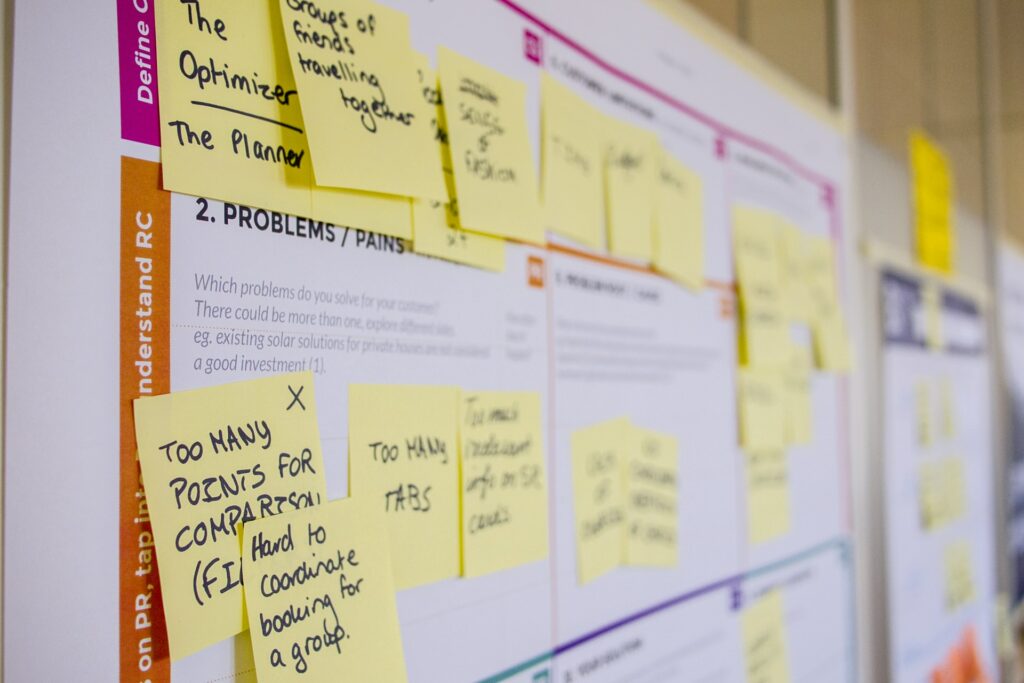
It can be useful to build a Stakeholders Hassle Map. The map will help you identify the real business issues that need to be improved during the modernization project.
So, interview the Stakeholders and start drilling down by asking them more specific questions, like the ones listed below (completed with the sets of possible answers):
- new functionality implementation
- UI/UX improvement
- latest security standards & compliance introduction
- bugs fixing
- performance improvements
- SLA improvements
What can be done to reduce IT costs?
- review & remove unnecessary IT assets
- conduct cost optimization
- review approach to software development
- organize shorter release cycle
- introduce Agile development practices
- implement modern DevOps practices
After you have outlined your Business Goals and figured out your Stakeholder Needs, you can start figuring out which parts of your system need to be modernized.
Identify Components and Processes for Modernization
The next step after interviewing CEOs and stakeholders is to provide an inventory of the existing apps and the platforms they are run on. After doing so you will be able to identify and prioritize things for your modernization project.
Here is a list of items, both IT system components and processes, that you might identify as good candidates for modernization, which you can then prioritize according to your business needs:
- Apps
- Data Sources
- Infrastructures
- Software Delivery & Engineering
- Management & Governance
- Operations
Finally, after settling on areas of modernization, you can move on to answering the last question: what drivers of modernization should you use? So before starting an application modernization initiative, it is important to assess the current state of the application and its supporting processes. A structured modernization assessment provides visibility into technical constraints, operational friction, and areas of high toil, helping define a realistic and effective modernization strategy. According to AWS Well-Architected Framework recommendations, there are 6 core pillars that every modern application should have:
- Operational Excellence
- Security
- Reliability
- Performance Efficiency
- Cost Optimization
- Sustainability
We can assess your app for modernization readiness to provide visibility on each pillar. So you can get a detailed report of your platform, provided by our AWS certified solutions architects, and then you can choose the right drivers for your modernization project.
Best Application Modernization Strategies
There is no one-size-fits-all formula for cloud-native application modernization, as the specific application modernization strategy will depend on the unique characteristics of the application, the business requirements, and the goals of the modernization effort. However, there are some application modernization best practices that can help increase the chances of success.
Apply Suitable Application Modernization Approach
There are a variety of Application Modernization Approaches you can choose from to apply to your modernization project. Depending on the project needs, you can choose a particular approach, or use a combination of multiple approaches, and either apply them to some part of your system, or to the whole system itself.
But no matter which option you choose to pursue, picking an App Modernization Approach is considered a key decision which will impact the scope of work, the timeline, and the budget of the whole modernization project.
The most common application modernization approaches are listed below:
- Rehost approach, also known as the “lift-and-shift” approach, stands for migrating AS IS, meaning the migration is done without implementing any cloud optimizations. It works well when the migration has to be done quickly.
- Relocate approach is used when the apps, data, and operations need to be transferred to a cloud environment without any further modifications. For instance, the relocate scenario is often used to move an existing cloud infrastructure to a different AWS Region or AWS account.
- Replatform approach works well when there is no need to change the application logic and architecture. In this instance, the tangible benefits of using the Replatform approach come from switching the on-premises databases and application servers to fully managed AWS cloud services and/or platforms.
- Refactor approach is the best option in situations where it is required to re-architect an existing application in order to add new features and meet business needs in terms of scale and reliability. The refactor scenario can be considered as the most beneficial strategy, as it infers using modern technology and cloud-native features.
Align Teams and Operating Model
The prevalent model observed across many organizations, particularly in the public sector, is a large amount of legacy infrastructure that requires constant management and updates. This often creates tension between development teams and operations teams, a situation that is sometimes further complicated by financial constraints and FinOps involvement.
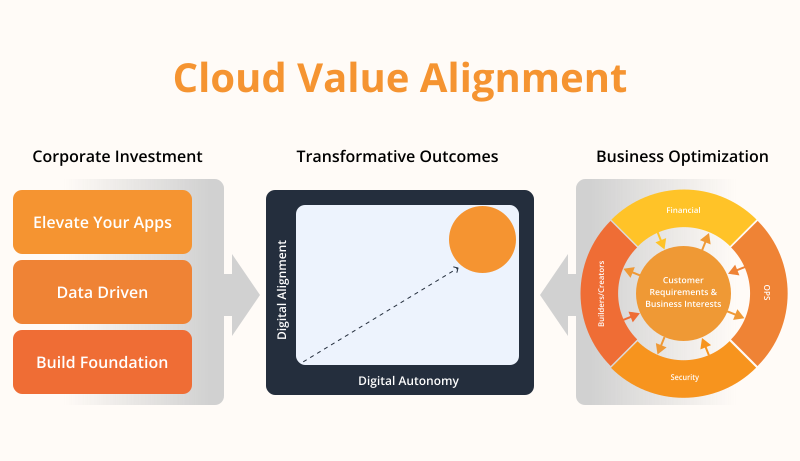
A unified operations paradigm requires closing capability gaps, meeting security and compliance requirements, improving alignment across enterprise teams, and developing sufficient financial literacy to manage systems effectively. When these areas are misaligned, they become major obstacles to digital transformation and, more specifically, application modernization.
Key challenges include:
- Capability gaps
- Security and compliance requirements
- Legacy approaches to solution development
- Lack of business alignment
- Lack of standardization and reuse
- Limited cloud financial literacy
So it’s important to ensure optimal efficiency and standardization within your organization, creating infrastructure as code and establishing a recurring model for builders and creators to follow is absolutely critical. By doing so, you can avoid developing monolithic software and instead focus on building microservices that can operate on containers.
Modernize Operations with SRE Principles
As teams operate the systems they build, automation becomes mandatory. For legacy workloads, applying an infrastructure-as-code approach with proper state management, using services such as AWS Config, helps prevent configuration drift and enables safe rollbacks to a known state. These practices align with site reliability engineering (SRE), which applies software engineering and automation to deliver reliable, resilient, available, maintainable, and secure systems.
The shift to hyperscale cloud providers removes the need to manage physical infrastructure, but it has increased the need to manage complexity. Managing infrastructure through code is no longer optional; it is the DevOps operating model that enables consistency and scale in cloud environments.
To support this model, organizations must invest in SRE capabilities. A capable SRE team improves system reliability while reducing manual work and repetitive operational tasks. Developing these capabilities often means upskilling traditional system administrators in scripting and programming. In cloud architectures built around services and APIs, engineers who can automate and codify operations play a critical role in maintaining stable and scalable systems.
Shift-Left DevSecOps Enablement
Many organisations distribute DevSecOps responsibilities unevenly, with most effort concentrated in operations, followed by security, and only then development. This imbalance increases operational load, slows delivery, and limits developer involvement in reliability and security decisions.
The strategic goal of shift-left DevSecOps is to move responsibility for security, reliability, and operational quality earlier in the development lifecycle. This enables developers to work closely with security and operations teams while changes are still inexpensive to make. In organisations that have historically invested heavily in security and operations functions, achieving this balance requires deliberate reallocation of effort rather than incremental adjustments.
A practical starting point is to identify where security, compliance, and operational issues currently consume the most manual effort. These activities define what must be addressed earlier in the lifecycle and form the basis for systematic improvement.
Embedding Security and Reliability into the Pipeline
Once teams can deploy changes consistently, DevSecOps execution relies on embedding security and reliability controls directly into the delivery pipeline. SRE practices play a key role here by introducing automated mechanisms that detect, mitigate, or recover from failures without manual intervention.
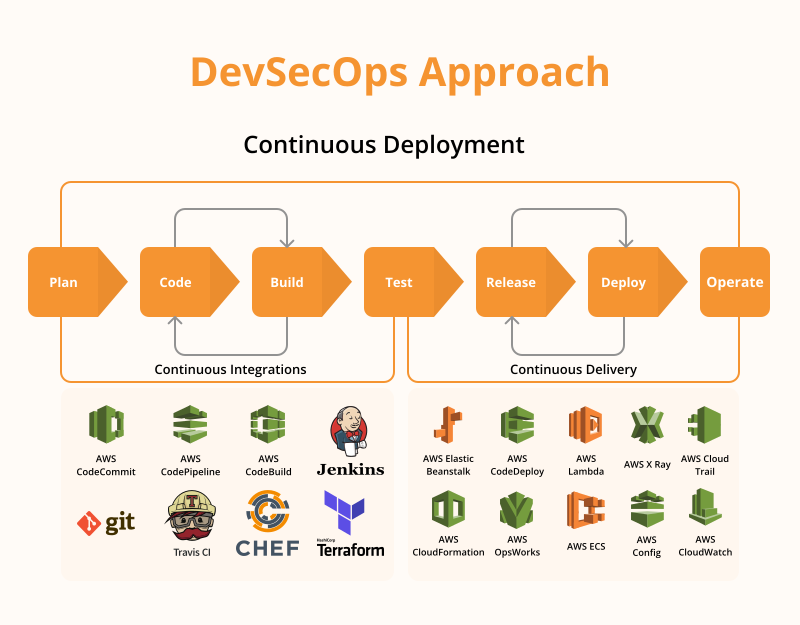
In many enterprise environments, application failures are still handled reactively. A system administrator logs into a server, identifies an unresponsive service, and restarts it to restore availability. While this may resolve isolated incidents, it is disruptive, slow, and does not prevent recurrence.
A software-oriented approach treats infrastructure and operations as programmable systems. SRE teams implement runbook routines that automatically restart failed services based on predefined KPIs or failure conditions. Load-balancing mechanisms can redirect traffic away from unhealthy instances, maintaining service availability without user impact. Security checks and testing are integrated early in the pipeline, allowing vulnerabilities and misconfigurations to be addressed before deployment rather than during production incidents. These execution practices convert reactive operational work into deterministic, repeatable processes that scale with the system.
By systematically identifying manual operational tasks and converting them into automated, backlog-driven work, organisations reduce recurring incidents and operational noise. Engineering effort shifts away from break-fix activities toward building and improving product functionality.
Developers gain the ability to deliver features with embedded security and reliability, while operations teams focus on improving platform capabilities rather than responding to repetitive failures. The result is increased engineering capacity, lower downtime, improved user experience, and a delivery model that supports continuous innovation without proportional growth in operational overhead.
Development, security, finance, and operations should operate as a single system. A DevSecOps approach, applied with a software-centric mindset, enables shared automation that can be reused across teams and environments and is essential for extracting value from the cloud.
Building reusable infrastructure code requires upfront effort but reduces configuration drift and operational overhead. The same approach applies to legacy applications through shared services that limit manual management. With limited engineering capacity, shifting work earlier in the development lifecycle prevents operational issues from reaching production. When app modernization introduces uncertainty around scope, sequencing, or technical trade-offs, Romexsoft’s team can help assess the application and define a practical modernization path.
Based on our experience, an effective application modernisation strategy for companies prioritises customer experience, cost efficiency, and business continuity. Continuous application modernisation allows teams to deliver features and improvements without disrupting operations and is a standard practice among hypergrowth companies and enterprises.

Frequently Asked Questions
Application modernisation relies on a combination of cloud-native, architectural, and automation technologies that improve scalability, reliability, and delivery speed. Key technologies include:
- Cloud platforms (such as AWS) to provide elastic infrastructure and managed services;
- Microservices and API-based architectures to decouple application components;
- Containers and orchestration platforms (Docker, Kubernetes) for consistent runtime environments;
- CI/CD pipelines and Infrastructure as Code to automate builds, deployments, and environment management;
- Managed databases and messaging services to modernise data storage and integration;
- Monitoring, logging, and observability tools to improve operational visibility;
- Built-in security and DevSecOps tooling to enforce security controls throughout the delivery lifecycle.
Here is a clear, structured software modernization process:
- Assess the existing application to understand architecture, performance, security, and cost constraints.
- Define modernisation objectives based on business and operational priorities.
- Choose the modernisation approach such as rehost, replatform, refactor, or re-architect.
- Design the target cloud architecture including integrations, data flows, and security controls.
- Modernise in phases to minimise disruption and manage risk.
- Automate deployments and infrastructure using CI/CD and Infrastructure as Code.
- Test, validate, and optimize performance, security, and costs.
- Establish ongoing operations and improvement with monitoring and continuous optimisation.
To ensure the success of their application modernization strategy, businesses should start by clearly defining their goals and objectives. This includes understanding the needs and expectations of stakeholders, as well as the specific challenges and opportunities presented by their existing applications. From there, businesses should develop a detailed roadmap for modernization, outlining the steps to be taken, the resources required, and the expected outcomes. Throughout the process, it's important to monitor progress, measure results, and adjust the strategy as needed.
During cloud migration approach legacy application modernisation by selecting the appropriate migration strategy for each application, such as rehost, refactor, retire, or repurchase, based on expected value and effort. While refactoring often delivers the greatest long-term benefits, fully re-architecting every legacy application is rarely practical. In many cases, outdated systems can be retired, while others benefit from selective or opportunistic refactoring that modernises the application alongside its surrounding environment.
Modernisation should also extend beyond application code. Cloud migration creates opportunities to improve how applications are deployed, managed, and protected. This includes introducing safer deployment patterns such as load balancing and blue-green deployments to reduce risk and downtime during releases.
For data-intensive workloads, moving databases to managed cloud services allows organisations to improve performance, reliability, cost control, and security without extensive code changes. Leveraging native cloud capabilities enables incremental gains while avoiding unnecessary rewrites.