Comprehensive Guide on AWS Application Modernization
Free up your time and focus by getting the most essential information on software modernization in a detailed but concise guide to Application Modernization on AWS Cloud. We’ve put together an article which will leave you doubtless on a perplexing and complicated topic of app modernization.

Table of Contents
Let’s say you are contemplating digital transformation or have even resolved to modernize your solutions. The idea of a one-time investment of resources in upgrading your systems to deliver better services faster and more efficiently is indeed tempting. However, application modernization is a continuous part of application evolution which is brought about by general technological advancement in the market. To continue delivering value to users, businesses invest in updating their legacy environments using modern, cloud-ready architectures and services.
As you commence your application modernization journey, teams often face uncertainty across both business and technical dimensions. Being a complex and laborious process, modernization will ultimately become a temporary patch for your business objectives and won’t be reimbursed unless conducted correctly in all of its intricacies.
AWS app modernization could refer to such attempts targeted at deriving long-term value from existing systems by refactoring, re-architecting, or re-platforming workloads in the cloud. When modernization is treated as a partial or ad-hoc effort, it typically fails to deliver measurable business outcomes. Sustainable results depend on addressing architecture, operations, security, and automation together, rather than applying isolated technical changes.
This article has been created to clarify the concrete and consistent steps which need to be taken in order to launch, carry out application modernization on AWS successfully. Having perused it, you will get confident in both theoretical and practical foundations of modernization so that you can ensure its optimal execution, including setting up your requirements so as to its pace, strategy, stages, and outcomes.
Table of Contents
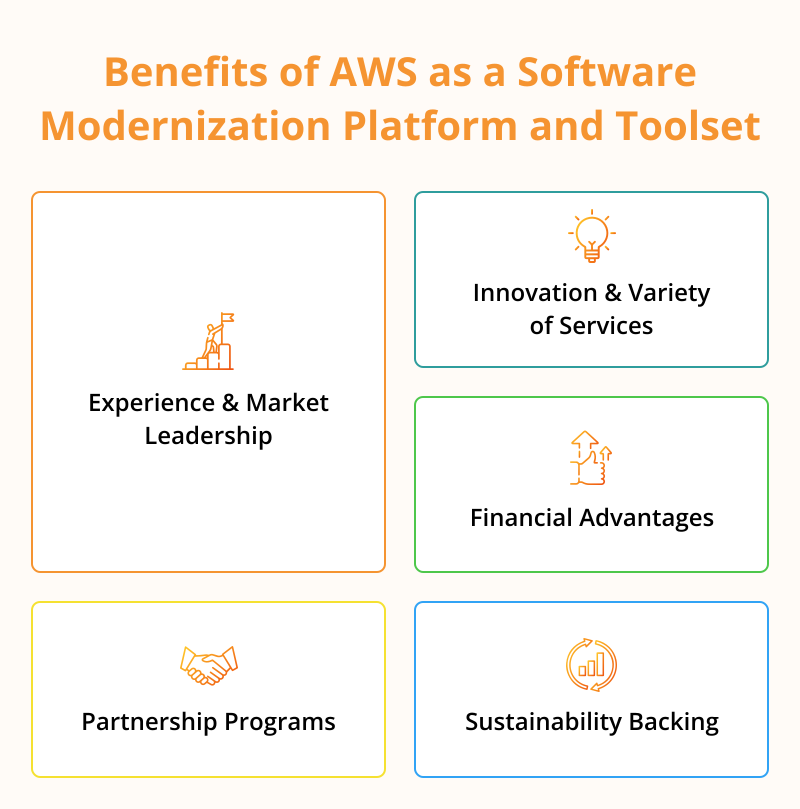
Benefits of AWS Application Modernization
Application modernization is typically driven by three core factors: cloud computing adoption, market competitiveness, and the need for greater effectiveness and efficiency. With these drivers in mind, we will shift our focus to a different question, being why choose Amazon as a kind of platform for the modernization of legacy apps.
Experience and Market Leadership
Just like when it was the first company to set foot in the cloud computing market, Amazon Web Services (AWS) is still the leading cloud-based service provider according to recent research by HoloriHolori. Bringing in the lion’s share of Amazon revenue, AWS is an absolute leader in the number of customers, including the highest-rank names like LinkedIn or Netflix, which also testifies to the service quality and reputation.
As the pioneer of these, AWS has the largest portfolio (of over 240 items) of the most diverse cloud services. At the same time, AWS invests the means into their cloud platform’s ceaseless evolution, both from the standpoint of new services development as well as geographical availability and data centers’ construction in different parts of the globe.
Innovation and Variety of Services
AWS continues to differentiate itself through a combination of platform maturity and service breadth that directly impacts how quickly organisations can deliver and evolve applications. The research by IDC shows that organisations running workloads on AWS free up 73% more staff time for innovation by reducing undifferentiated operational work through the use of managed cloud services. This reclaimed capacity allows teams to focus on feature development, architecture improvements, and product evolution rather than infrastructure maintenance.
The same research indicates that AWS customers deliver new features more frequently and accelerate delivery cycles as a result of higher levels of automation and managed service adoption. Instead of building and operating foundational components themselves, teams can rely on AWS-managed compute, database, security, and monitoring services to move faster with lower operational risk.
From a platform perspective, AWS offers one of the broadest portfolios of cloud services, covering infrastructure, databases, containers, analytics, integration, security, and application services. This breadth enables organisations to modernize legacy applications incrementally, while maintaining control over architecture, pace, and cost.
Engineering Partnership Programs
The market’s need for an international community of partners to share their experience and professionalism in designing, presenting and monetization of their customer offerings, got a response in the form of the AWS Partner Network (APN). Today, the number of this network’s partners from more than a hundred countries globally exceeds a hundred thousand.
APN helps accomplish companies’ business goals and make the most of the available AWS cloud-based services and products, including cloud application modernization and migration.
Encouraging networking, the AWS Partner Network aids in finding the perfect vendor that boasts of:
- experience in constructing AWS-based, or -integrated, solutions;
- well-architected products for AWS customers;
- a strong bench of AWS-certified professionals.
Financial Advantages for Clients
Experience proves that with application modernization, organizations notably bring the TCO down. AWS also contributes to the business’s cost efficiency by providing a large number of highly automated services. Cost savings aside, what cooperation with AWS brings about is enhanced operational resilience, employee effectiveness, and business agility.
IDC has lately interviewed almost half a hundred respondent businesses around the world to issue a report which proves AWS’s contribution to boosting the client’s business’s evolving and aiding in cost optimization. The average annual benefit of about $33,600 per AWS EC2 virtual instance, which equals to $26.4 million of annual benefit per organization, was arrived at upon surveying 42 AWS customers. The benefit was brought about through the following four factors.
- IT staff productivity
The respondent companies claimed that after integrating with AWS their IT teams enjoyed increased effectiveness, agility and operational capabilities. According to the report, the average gain from optimizing employees’ efficiency amounted to the average sum of $17,100 per AWS EC2 virtual instance, or $13.4 million per organization. - Business productivity
The report-featured AWS customers maintain having obtained more significant business outcomes. The cloud services shortened their time-to-market and thus impacted their user experience, which raised the average expected revenue by $11,600 per AWS EC2 virtual instance, i. e. $9.1 million per organization. - User productivity
The IDC study participants testify to lowering the operational hazards and, consequently, financial losses caused by unforeseen outages and compromised security. In this respect, AWS promoted the customers’ business productivity by the net revenue worth of yearly $3,400 per AWS EC2 virtual instance, that is $2.6 million per organization. - IT infrastructure cost
The surveyed businesses decreased IT support expenses as they, prompted by AWS, shifted to opEx-focused models with just-in-time provisioning models. The report goes on to estimate savings of an average of $1,500 per AWS EC2 virtual instance, being $1.2 million per organization.
Sustainability Backing
As the current world’s most all-embracing and globally functioning cloud-based IT offering, AWS strives to construct and maintain a sustainable business by focusing on delivering efficient service to meet the customer’s needs and expectations on the one hand and minimizing the environmental implications of carrying out the business on the other.
- Energy efficiency
Every facet of AWS infrastructure is designed with the thought of efficient use of resources, the same holds true for projecting the impact of functional processes. By integrating with AWS, businesses can assimilate the experience of improved efficiency. - Lower carbon emission
Studies by 451 Research show that, contrasted with the organization data centers, AWS can now decrease the clients’ workload carbon footprints by almost 80%, with the anticipated number of up to 96% when AWS reaches its goal for 2025 of being powered with renewable energy exclusively. - Renewable energy investment
With that goal stated, Amazon invests in accomplishing net-zero carbon for each operation by the year 2040. Its renewable energy projects will not only significantly reduce the ecological burden but also provide funding for employment and further investments.
Key AWS Application Modernization Phases
What most solution owners target when modernizing is investment and revenue optimization. However, AWS app modernization is a lot more faceted than that. It majorly revolves around technological updates that enable faster and fuller value delivery as well as cost-efficient business scaling. On top of that, modernization is no single move ensuring the desired benefits. Rather, it is a way of continuous efforts to run within a new model, which in turn, entails simpler and more effective functional and business processes.
Speaking plainly, modernization is about transforming a legacy app environment into its increasingly agile, scalable, resilient, and available version on AWS. While the operational side of your environment can admittedly be promptly migrated to AWS, suppose through the lift-and-shift migrating strategy, the same can’t be said about modernizing the inside structure and culture of your organization.
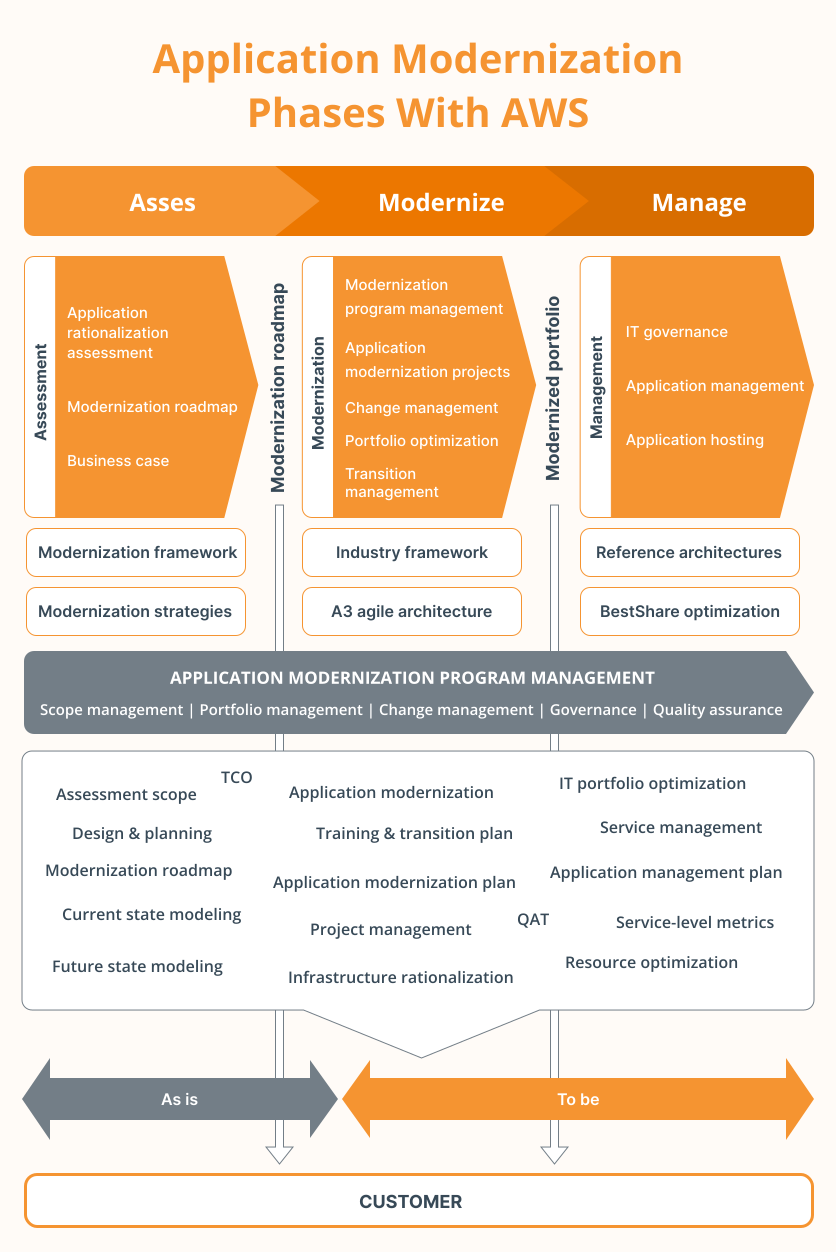
We regard application modernization as an iterative process in which the later stages are determined by the more profound initial steps. The latter ones will be referred to within this article as assess, modernize, and manage phases.
Assess
The foundation for successful application modernization is laid by compiling and thoroughly analyzing the app portfolio, selecting and evaluating the infrastructure to be modernized, and designing and carrying out a modernization plan, based on the appropriate strategy. In preparation for the Assess phase, we advise you to check out the application modernization questionnaire that helps review your current systems from different perspectives to diagnose the future state of architecture within a new modernized infrastructure.
Activities to perform during the first app modernization phase:
- app assessment through five lenses:
- strategic or business fit,
- functional adequacy,
- technical adequacy,
- financial fit,
- digital readiness.
- app grouping, ranking, and sequencing;
- documenting target and interim operating models;
- understanding of technology and regulatory requirements;
- determining apps in need of extensive data migration;
- clarifying the scope of data to be converted.
Outcomes of the completed assessment:
- application modernization blueprint;
- technical and functional architecture for the target state of an app according to the requirements set by the five lenses, mentioned above.
Modernize
The following phase is modernization proper. The idea behind it is to establish project objectives and resource requirements that enable the creation of a detailed modernization roadmap according to the selected strategy whose execution results in an upgraded, reliable and agile app architecture.
Activities carried out within the Modernize phase:
- diagnosing the control points for transforming the app’s current code and data;
- surveying the functional requirements for running and managing the target infrastructure;
- executing the solution that satisfies the agility, resiliency, availability, and adaptability needs with cloud-based procedures and the most progressive approaches. A modernized app is supposed to be designed:
- as lightweight containers;
- as loosely coupled microservices;
- around APIs for interaction and collaboration;
- with a separation of stateless and stateful services;
- in isolation from the server and operating system dependencies;
- to be deployed on self-service cloud infrastructure;
- to be run through agile DevOps processes;
- featuring automated capabilities;
- to ensure specified, policy-driven resource allocation.
Outcomes of concluding Modernize phase:
- target state data model design;
- organizational readiness;
- sequences modelled for change activities;
- optimized operating model and delivery effectiveness review;
- key business case metrics monitored for value delivered;
- further upgrading and automation activities;
- a roadmap with the strategy for each application;
- modernization reparation and implementation.
Manage
Post-modernization activities call for a certain amount of retraining as the proper maintenance and further risk-free upgrading of modernized applications are based on a thorough understanding of the new app characteristics. Adopting the cloud-native features of modernized applications, like microservice operations, signals forming a site reliability engineering (SRE) capability within the organization. The management phase concerns change and program supervision, as well as quality assurance, to maintain that modernized applications remain reliable, secure, and cost-efficient over time while supporting continuous optimisation and future enhancements.
How to Perform an AWS Application Modernization Assessment
Taking into account that each modernization journey is unique, modernization evaluation diagnoses the present-day condition of the legacy environment in order to decide on the prospective modernization steps. The readiness review provides a deep understanding of the current state of the infrastructure as well as how it could support your legacy apps after modernization and serves as a basis for the upcoming modernization strategy and roadmap.
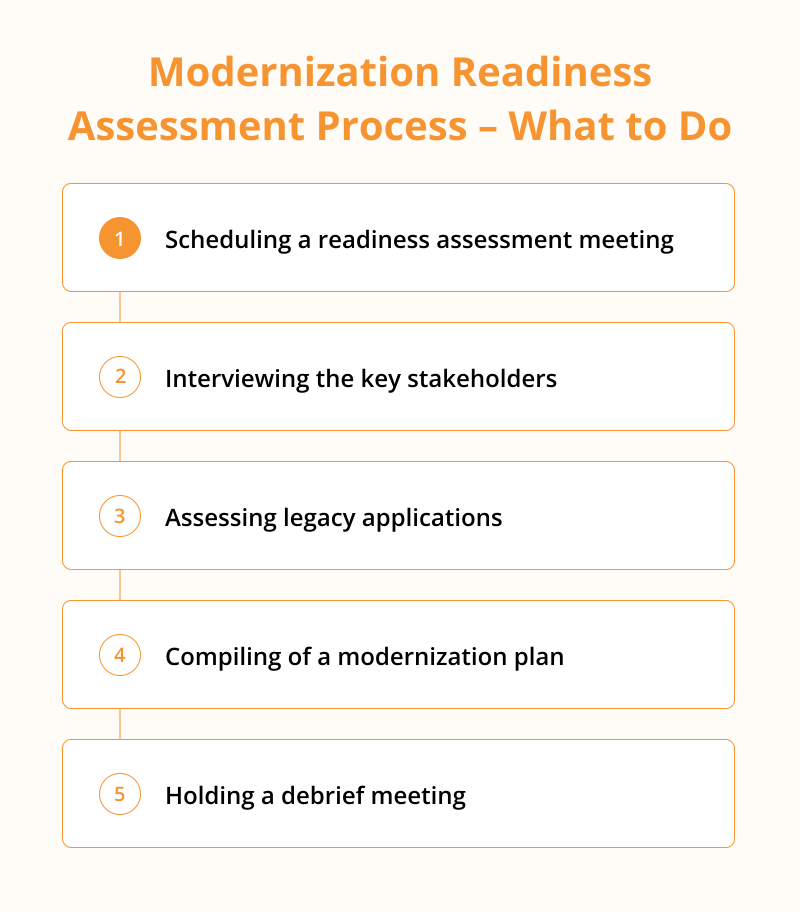
A readiness assessment consists of these five tasks:
- Scheduling a readiness assessment meeting and requesting attendance.
- Interviewing the key stakeholders or personas for each application suite. At the initial meeting, it’s important to establish the business priorities as well as decide on the applications that necessarily have to undergo a modernization assessment. The stakeholder’s motivation should be recognized and aligned with the tech teams of the business. What helps to reconcile these sides and reach an agreement on resource allocation is a vision workshop that also crystallizes the key details for the modernization strategy.
- Assessing legacy apps so as to their modernization readiness, and via additional resources.App modernization questionnaire, recommended by AWS and provided in the appendix, supplies essential data, which being thereafter scrutinized and recorded govern the next steps of modernization planning. The readiness review can be strengthened by additionally assessing core apps through the five lenses, mentioned in one of the previous subsections, namely the Application modernization approach on the AWS cloud.
- Compiling a modernization plan. It is helpful to get an unambiguous understanding of the vital and the secondary within the system, especially when it comes to apps that can be re-platformed, re-architected or replaced. A drafted plan will then give rise to a necessary document, which is a modernization blueprint.
- Debrief meeting.The last step is carried out in order to ascertain and align the discovered data and put them to use in designing a modernization roadmap which includes the business plans, the risk factors and strategies for each of the core applications selected. That’s already the first tangible step towards modernization execution.
You can expect the following outputs from the app readiness assessment process:
- an out-brief deck with an outline of findings and the next steps;
- a meeting scheduled to examine the outputs and the following steps;
- estimates and a proposal, e.g. a statement of work (SOW), and a clearly defined minimum viable product (MVP) solution.
Having completed the vision workshop, you can then expect an extended modernization team to carry out an inception engagement, with the aim of:
- reaching alignment among broader stakeholder groups;
- defining high-level technical solutions for the set business outcomes;
- developing a modernization roadmap with detailed phases and documented milestones;
- kicking off the initial setup of cloud foundations by using landing zone templates and AWS Control Tower automation.
Best Practices for a Successful AWS Modernization
An important initial step to that is putting a finger on the best-suiting modernization approach, this can be predetermined as early as in the Assessment phase. From our experience implementing application modernization projects on AWS, we consistently observe that most modernization initiatives fall under one of three commonly accepted approaches, each of which is suitable for different technical and business contexts. These approaches can be distinguished and selected based on the methodologies used:
- serverless computing (the new generation of applications born in the cloud);
- re-platforming (applicable to cloud modernization and migration);
- decomposing monoliths into microservices (suitable in both cases).
With AWS application transformation and app modernization on AWS in particular, being a strategic priority, we recommend looking into those modernization approaches more thoroughly.
Decomposing Monoliths into Microservices
Most legacy apps are launched as a single deployed unit. Their monolithic architecture is justified in circumstances of representing a particular use case, or smoothening design inaccuracies. At the same time, as apps develop, or better still, are modernized, their monolith architecture becomes more of a stumbling block than an aid: monolithic internal structure increases the maintaining cost and effort, resists scaling and innovation of the solution on the basis of a poor cohesion-coupling proportion, to say nothing of the burden on the staff brought about in releases or expansions.
To avoid those and many more by-products of sticking to the architecture of legacy systems, while individual application modernization steps may vary, one of the earliest ones is still decomposing the legacy system monoliths into microservices. Before commencing any work, one had better be fully aware of the monolith’s technical interdependencies and the business use case. This allows the upcoming evaluation of the monoliths to determine which ones are to be decomposed or included in a tightly coupled architecture – for those with performance issues.
Outcomes from decomposing:
- smooth transition from legacy monoliths to microservices;
- seamless adaptation to change in demand with no disruption to scalability, resilience, reliability and continuous delivery;
- speedy innovation through faster deployment of separate microservices.
According to the needs and original data, one is supposed to pick an appropriate decomposition pattern and put it forward among the teams involved. The patterns could be chosen according to the next decomposition dimensions
Business capability
Your business capabilities can be employed in monolith decomposition. They refer to the business’s activities devoted to delivering its value. With the majority of organizations having more than one business capability within different sectors, you can decompose by business capabilities on condition that your teams or subject matter experts have a working understanding of your business units. Each of the decomposition approaches has its pros and cons, those of business capability-based decomposition will be discussed further.
Advantages of decomposing by business capability:
- stable business capabilities result in stable microservices architecture;
- DevTeams are arranged to deliver business value, focusing not only on the technical side;
- loosely coupled services.
Disadvantages are:
- the business model is in tight coupling with the app’s architecture;
- the need for a detailed understanding of the business processes in order to recognize the business capabilities in question.
Subdomain
The subdomain decomposing approach is anchored in domain-driven design (DDD). In short, the pattern describes separating subdomains within the business’s domain model. Subdomains are later defined as core, supporting, or generic, according to the significance and differentiator factor to the organization.
The given approach will provide the most smooth decomposition for the monolithic environments with clearly defined subdomain-related modules. With boundaries established around separate modules, the latter can be repackaged as targeted microservices with no source code alteration.
Advantages of subdomain decomposition:
- time- and protocol-independent, maintainable and reliable infrastructure;
- predictable scalability of solutions.
Disadvantages could include:
- multiple microservices generate confusion in integration;
- subdomain identification is burdensome in absence of a profound understanding of the business.
Transactions
For systems based on distributed computing, one business transaction requires the involvement of numerous microservices which can lead to a response delay or a two-phase commit issue. To avoid these, one can resort to grouping microservices, elicited from the transactions they initiate. You will find this pattern suitable if your business prioritizes response time, and your system’s modules don’t form a monolith once packaged.
Advantages of transaction-based decomposing:
- speeded up response time;
- data consistency at the end of the transaction;
- expanded availability.
Disadvantages of the approach:
- packages of grouped microservices can form monolithic architecture;
- сomponents that fill microservices are costly and challenging to maintain;
- microservices involved in transactions extend alongside business domains dependencies;
- the same business domains set off inconsistent versions of microservice groups simultaneously.
Service per Team Pattern
What sets this approach apart from others is that microservices resulting from decomposition are run by individual teams. Being in charge of the code database, they can develop, deploy, and test the microservices on their own. One microservice is typically supposed to be run by one team, though subteams with divided responsibilities are also possible within one microservice.
Advantages of the service per team approach:
- minimized team coordination management;
- code databases remain separated and not shared among outside teams;
- faster innovation for microservice features;
- benefits of application of different frameworks, or programming languages.
Disadvantages are:
- complicated alignment of teams to get unified business capabilities;
- extra effort for delivering coordinated app increments.
Integrating Microservices Using AWS Serverless Services
We’ve now come to establish that rearchitecting the organization’s monolithic infrastructure into a set of microservices is essential to overall strategic software modernization. In addition, we’ve also looked into the most common decomposition patterns suitable for such a transition alongside their typical merits and demerits.
What follows then, though, shouldn’t be overlooked, as microservices’ integration into the present app architecture could either be a final step towards a more robust, reliable, scalable, cost-efficient and accessible solution or, if neglected, sabotage the desired outcomes you’ve commenced the modernization for. Integration of microservices tied up to business transactions immediately affects the users’ experience; if incorrect, it leads to delayed response times, integrity problems or information loss.
On AWS, microservices integration is commonly implemented using serverless services, which reduce coupling between services and remove the need to operate custom middleware. There are three serverless AWS-based patterns that can be followed for successful microservice-architecture integration:
API Gateway Pattern
One is advised to consider the API gateway pattern to architect a complex solution that supports numerous user applications and is based on microservices. Functioning as a synchronous interface mediator between the user and the microservices, the API gateway pattern internally routes the user’s requests to the microservices endpoints. This reverse proxy service can be also supplemented by request transformations and tracing, or endpoint access authorization.
API gateway pattern is recommended in cases of:
- manageable and constant number of microservice dependencies;
- prioritizing synchronous responses from the microservice to the call;
- unsophisticated latency requirements;
- need for data collection from multiple microservices by one API.
Decouple Messaging Pattern
Contrary to the API gateway pattern, this approach is based on asynchronous user-microservices communication, enforced by Amazon Simple Queue Service (Amazon SQS) or Lambda. Any synchronous communication model could create response time delays and input/output operations (IO), among other issues. The decouple messaging pattern prevents those with the help of an asynchronous poll model which enables asynchronous processing of the previously admitted calls.
The decouple messaging pattern works best if your system allows:
- loosely coupled architecture;
- asynchronous operations instead of completing all operations in a single transaction;
- handling the calls, which were sent to the queue, as the resources are freed up due to the downstream system’s inability to cope with the incoming TPS rate.
This pattern comes with its downsides as business transaction actions are synchronous. Admittedly, when the caller receives a system response, the request may still be processed. Fitting the fire-and-forget interaction model, decouple messaging pattern provides the user with the transaction status after polling the service with a request ID.
Pub/Sub Pattern
Within an extending system, interaction among microservices more often than not produces interdependency. This can be avoided by utilizing the publish/subscribe (pub/sub) model of asynchronous interaction, through such services as Amazon SQS, Lambda or Amazon Simple Storage Service (Amazon S3). According to this pattern, events are published in the shape of messages into a channel that subscribers are exposed to; this is what allows parallel operations, message caching, and tree-based routing among other features offered by the publish/subscribe pattern.
It is worth considering the pub/sub pattern on condition that you:
- have an event-driven architecture;
- can enable loosely coupled microservices;
- needn’t synchronicity between the call and response for a transaction;
- aim at scaling which exceeds the capability of a data center.
As to the pub/sub model’s drawbacks, while it publishes messages to channels, it doesn’t assure the publisher that a particular subscriber is listening to a particular channel, nor does the pattern guarantee a message’s delivery to all kinds of subscribers, except for when used with a service like Amazon Simple Notification Service (Amazon SNS).
Enabling Data Persistence in Microservices
The monolithic database of most of the legacy apps, which we are trying to progress away from, virtually disables the creation of decentralized and independent components that can contribute to microservice architecture, not to mention complicating schema change, forcing a single point of failure or a technology lock-in with vertical as the only way to scale.
Decentralizing databases means fostering polyglot persistence among your microservices and determining data storage technology according to the requirements of your microservices, unlike the other way around with monolithic data stores. The latter isn’t easy to break down and restructure, but it leads to data consistency, independent microservice scaling and low-impact schema change, and ultimately, enhanced app performance.
However, decentralized polyglot persistence also has unfavourable consequences, typically connected with data synchronization, transactional integrity, data duplication, and response time.
If you favour the opportunities that data persistence can open up to your microservices, here’s how it can be integrated:
- Database-per-service pattern;
- API composition pattern;
- CQRS pattern;
- Event sourcing pattern;
- Saga pattern;
- Shared-database-per-service pattern.
Re-platforming
This approach to application modernization is most similar to transferring the apps in their original condition. Rarely applied in that non-intrusive way, re-platforming mostly features minor modifications, such as replacing individual components with more cloud-compatible ones, rescripting the program’s interaction with the database, etc.
At the same time with moving an app to the cloud platform, one can easier experiment with cloud-based methods and tools to achieve improved operation, optimized spending, faster scaling, increased accessibility and the like, while keeping the core app architecture intact.
The undeniable advantages of the re-platforming approach are:
- adoption of cloud-native functionality;
- higher application availability;
- no downtime or compromised security while migration;
- optimized cost by avoiding licensing expenses.
The re-platform migration strategy is your use case if you are willing to save resources by moving to a fully-managed or serverless service in the cloud – you can achieve it through:
- using custom-built processors developed by AWS (AWS Graviton Processors);
- moving from a Microsoft Windows OS to a Linux OS;
- strengthen your security and compliance stance by upgrading your OS to the latest version;
- enhance the app’s performance – you can achieve it by migrating virtual machines into containers, with no code change. Your .NET and Java apps can be modernized into containerized apps by using the AWS App2Container migration tool.
Special Case for Big Data Solutions
The big data solutions issue of the fast accumulation of large amounts of data, and information storage in classic databases is still pertinent for developers. For this reason, using big data outside the cloud environment is pointless: on-premises databases are unable to cope with huge volumes of information or scale as needed; one had better initially design such solutions utilizing Elasticity Cloud Storage. The analytical solutions system on AWS was created to cover those needs of managing masses of data, as well as design, secure and easily scale end-to-end big data apps.
Big data solutions require a modern way of architecting applications, which features:
- Scalable data lakes
The AWS data lakes combine the unparalleled accessibility, agility and elasticity of Amazon S3 among other cloud providers with insightful data analytics. When it comes to setting up and running data lakes manually, it does take lots of time and focus. Covering this need, AWS Lake Formation offers a great level of automation in designing and securing information times faster, aside from the top durability and accessibility of more than 99.99%, robust security and compliance, flexibility and attractive subscription pricing. - Purpose-built analytics services
The depth, detail and computing capacity of traditional analytical tools are scarcely enough to examine the never-ending traffic of big data. To avoid unnecessary spending on extra capacities or hardware, one had better follow the pay-as-you-go AWS cloud computing model which enables optimized cost as well as easy horizontal or vertical scaling depending on the demand. - Unified data access & governance
Moving, replicating and combining your data throughout data stores and the lake has never been simpler than with such AWS services as AWS Glue, specializing in data integration, or Amazon Redshift, pursuing data querying in one’s S3 data lake. - High performance & cost-efficiency
Along with dominating the cloud provider market in their high performance and computing capacities, AWS also offers the leadingly favorable pricing for their analytics. To illustrate, AWS charges for data lake services start from less than 1$ a TB of data monthly whereas Amazon S3 intelligent tiering allows the customers to economize nearly 70% on data storing.
While data lakes are demanding in terms of management of security, access and auditing due to their volume and complexity, AWS Lake Formation provides the centralized setting of your particular governance, auditing and compliance policies for every industry or location.
How Romexsoft Can Help with AWS App Modernization
In practice, successful modernization depends not so much on individual technologies as on the application of the right models at the right stage. Romexsoft’s specialists have participated in AWS application modernization projects where legacy systems needed to be developed without disrupting active products or business operations. In all projects, we worked on modernization based on assessment, gradual architecture reorganization, and operational coordination using our own AWS services.
Here are some examples of how the AWS application modernization practices discussed earlier in this article are applied in real-world scenarios.
Healthcare Platform Modernization via Re-platforming
A UK-based digital healthcare marketplace faced growing operational overhead, scaling limitations, and slow release cycles due to a legacy, EC2-based infrastructure that relied on manual configuration and lacked automation. To address these constraints, the platform was re-platformed to a containerised architecture on Amazon ECS with Fargate, supported by infrastructure as code and automated CI/CD pipelines, enabling serverless container operations without managing underlying servers. As a result, the company achieved improved scalability, faster and safer deployments, lower operational effort, better cost control, and a stronger security and compliance posture suitable for healthcare workloads.
Decomposing a Monolithic E-commerce Platform
An outdoor equipment marketplace operating in the retail and wholesale e-commerce sector faced performance instability, limited scalability, and high operational overhead due to a rigid monolithic architecture. To support growing traffic and seasonal demand, the platform was modernized by decomposing the monolith into microservices running on Amazon ECS, with isolated services for storefront, administration, caching, and data management. As a result, the company achieved near-zero downtime during peak sales, improved resilience and auto-scaling, and reduced infrastructure costs by approximately 30% while accelerating feature delivery.
Enabling Scalable Data Persistence for Real-Time Content Analytics
An ad-tech company delivering AI-driven audio experiences needed to analyse massive volumes of real-time and historical content data to generate actionable performance insights. To address this, a dedicated content analytics system was built with modern data persistence and analytics architecture, combining streaming ingestion, a scalable data lake on Amazon S3, and purpose-built analytical data stores for reporting. The result was a cost-efficient, high-performance analytics platform that enabled real-time dashboards, long-term trend analysis, and data-driven decision-making without sacrificing scalability or operational efficiency.

Frequently Asked Questions
Application modernization on AWS Cloud is a process of updating legacy environments with progressive solutions to deliver value to increasingly demanding users. It involves upgrading the legacy architecture to function in cloud-based environments. AWS allows you to control the pace, degree, and approach of your application’s modernization, making the process customizable to your specific needs.
AWS migration is about moving applications to the cloud with minimal change, mainly to gain speed and reduce immediate risk. The architecture and operating model usually stay the same, which limits long-term benefits. Modernization, on the other hand, focuses on improving how an application is built and run by adopting cloud-native design, automation, and managed services. It takes more effort, but it delivers stronger gains in scalability, reliability, and cost efficiency. In practice, many organisations migrate first and then modernize gradually once their systems are stable on AWS.
When modernizing AWS applications, teams typically rely on a set of tools that cover assessment, creation, deployment, and operation. Here are examples of core services for each category:
- For assessment and planning, AWS Migration Hub is most commonly used to track progress, and AWS Well-Architected Tool is used to verify architecture against best practices.
- For building and modernizing applications, teams typically use Amazon ECS or Amazon EKS for containerized workloads, AWS Lambda for serverless components, and Amazon RDS or Amazon Aurora for modernized databases.
- For integration and delivery, Amazon API Gateway and Amazon SQS are commonly used to connect services and decouple components, while AWS CDK or CloudFormation support infrastructure as code.
- For operations, Amazon CloudWatch provides monitoring, logging, and alerting in modernized applications.
To keep an application modernization roadmap aligned with business outcomes, start by defining clear business goals and success criteria before planning technical work. Structure the roadmap so technical improvements support operational gains such as faster delivery and higher reliability, which then enable business results. Prioritise initiatives from foundational technical value up to customer and business impact, rather than treating modernisation as a purely technical exercise.
Reduce delivery risk by breaking modernisation work into small, manageable changes instead of attempting a full redesign at once. Architects and engineers should start with an assessment to identify dependencies, constraints, and high-risk areas. Developers then implement changes incrementally, while DevOps engineers automate builds, testing, and deployments with clear rollback paths. Operations and SRE teams monitor releases in real time and address issues early, before they affect users.