How to Build an Application Modernization Roadmap with Practical Insights
We have written this article to support professionals starting their first application modernization journey. It shows why a well-structured modernization roadmap matters, explains how the AWS application modernization framework fits into the process, and clarifies where to start when building your own roadmap. We also share practical guidance to help you create an effective application modernization roadmap step by step.
The cloud adoption trend has recently become so popular that businesses have started to try and systematize their app modernization processes. Continue reading to learn how you can develop a prescriptive app modernization approach for your company with creating hands-on application modernization roadmap.
To adopt a successful modernization strategy, you first need to identify your business needs and prioritize them according time-to-value, and then select a set of modernization technologies that will best fit your business objectives. In other words, this process starts with building a clear application modernization roadmap.
Why You Might Need Application Modernization
A lot of choices and decisions are to be made when one considers legacy app modernization. The first items in question are the possibility, practicality and profitability of modernization all of which actually can be debatable. When it comes to apps of critical business importance, though, modernization is a quickly redeemable investment.
A changeable technological landscape compels businesses to update their legacy applications in search of faster and more frequent deployments, more reliable and resilient workloads, enhanced app uptime and resource efficiency. Those are the most obvious and transparent business benefits reaped through modernization. While one may follow these selling words, we will shed a bit of light so as to what modernization means from three viewpoints.
Cloud Computing Perspective
The mere fact of modernization, its degree and direction depend on the strategic vision of your app system, balanced with resources at hand and the technological market’s offers, such as cloud-based infrastructure, microservice-based architecture and serverless environments.
It is obvious that while obsolete legacy systems cannot cope with the current technical requirements, with time it will gradually but surely lead to a complete failure in performing expected tasks. Timely conducted re-evaluation of your app’s adapting options will ensure your system’s operation and save you time, money and effort. In other words, app modernization relieves your developer team from treating old application-related emergent issues to devote effort to what really supports your business goals.
At the same time, it is worth considering that on-premises applications work best in their intended environment. As you attempt to incorporate them into the cloud, aiming at boosted performance, you will, in the best case, get limited functionality. Taking their relatively finite capacities into account, we see that legacy apps in the cloud will produce more short-range performance lags than expected business outcomes, while in the long run, they may impede the systems’ operation quality and the enterprise’s cost-effectiveness. Therefore, you need to be cautious when deciding to migrate to the cloud, and the safest option would be to consult a cloud migration consultant.
Market Competitiveness Perspective
While a company is hesitant to modernize and keep up with the market demands, it will lose clients to those which have already taken the most of the technological advancement and upgraded their business systems. Legacy app modernization is what will ensure that your business not only stays afloat in the harsh market environment but also possesses a competitive advantage over similar enterprises.
Achieve faster time to market and agility
Older legacy applications are typically designed upon monolithic architecture which makes it cumbersome and time-consuming to upgrade such apps or deploy their new versions. The simplest way to circumvent the imposed deployment limitation is by using containers and employing such a container orchestration platform as Kubernetes. You can also make a start in modernization by following DevOps best practices: adopting CI/CD fosters and speeds up app delivery.
A more profound step into modernization suggests refactoring the monolithic legacy apps to be separated into microservices, they allow for improving separate small units within one application. Microservice architecture can be as well reinforced by the said CI/CD to enable rollback to the previous well-functioning state if an update generates concerns.
Staying relevant
The digital world offers opportunities to meet any need and achieve any goal, and how businesses grasp them is through modernization. Machine learning, artificial intelligence, and cloud-based environments are there for anyone willing to create or improve their infrastructure for it to cover the market demand and be a favorable basis for the following transformations.Therefore, it should be borne in mind that such a legacy app may fail to compete with newly released upgrades, and ultimately stop being worthwhile.
Improved user satisfaction
Legacy applications can not only be burdensome to handle for your staff but also challenging to use for your customers. App modernization brings about the interface and functionalities that definitely increase customer experience, hence your business’s reputation.
Software modernization leads to improved app compatibility with the most recent technologies and code. This, in turn, allows smooth and seamless application integration to the market in order to satisfy the existing, as well as anticipated, demand.
Effectiveness and efficiency perspective
Digital transformation of your apps is meant for ultimate business performance enhancement. Applications that have undergone modernization can be updated with ease and whenever necessary; they are also supported by rollbacks, bug fixes and security patches to make the system improvement as smooth as possible. The result of modernization on this level is operational simplicity, and eventually, freed-up human resources that can be reinvested into new developments and innovations.
Developers productivity boost
Modernizing legacy apps facilitates the DevOps team’s work while increasing their efficiency and influencing a product’s time-to-market.
The development environment set up in apps after modernization is much faster, leading to the increase of employees’ motivation and productivity by up to just under twice as much. Containers or modular service-based architectures, which come to substitute older monolithic infrastructures, also enable different language implementation for faster recruitment of the right developer’s team which also opens up new career possibilities for skilled and qualified staff.
Robust security
Legacy applications have been proven to expose an enterprise to security threats, based on the research conducted among the industry decision-makers. Most modern security standards guarantee the utmost safety of sensitive and personal information which correlates with the brand’s credibility, reputation and competitive standing, while older systems simply don’t comply. The anticipated outcome of modernization is patching up vulnerabilities and significantly improved security posture.
How to Develop the Application Modernization Roadmap?
Although a modernization roadmap does not expand on every task in your development plan, it provides a clear view of where development currently stands and where it is heading. To better illustrate how goals, strategy, and project scope interact during modernization, we share our experience in developing a roadmap.
Application Discovery and Assessment
A sure-fire way to approach an app modernization project in its early stages is to conduct an application assessment. At this phase, you can delegate the assessment to a modernization vendor to catalog what you already have is often one of the most straightforward ways to start a drastic transformation like modernizing a monolithic app.
To create a productive application inventory list, plot your already existing apps on an X and Y axes, where one of the axes will represent the ease/difficulty of modernizing a given app, and the other will represent the increase in potential value of the application after modernization.
At the start, all current systems need to be examined so as to functional, business and financial criteria, apart from the technical one. Weighing up these factors within the assessment portfolio, a company can make decisions on which infrastructures are to be prospectively modernized, which digital transformation strategies are relevant to each app, which focus is to be kept within the preferred modernization approach, etc.
Define Goals and Drivers Definition
Start off with a clear understanding of your modernization project goals and a set of success factors. Gather insight on the project scope, general start and end dates, and compile a list of tasks to be completed to reach the above mentioned project goals. You will use this information later on to create a detailed project schedule.
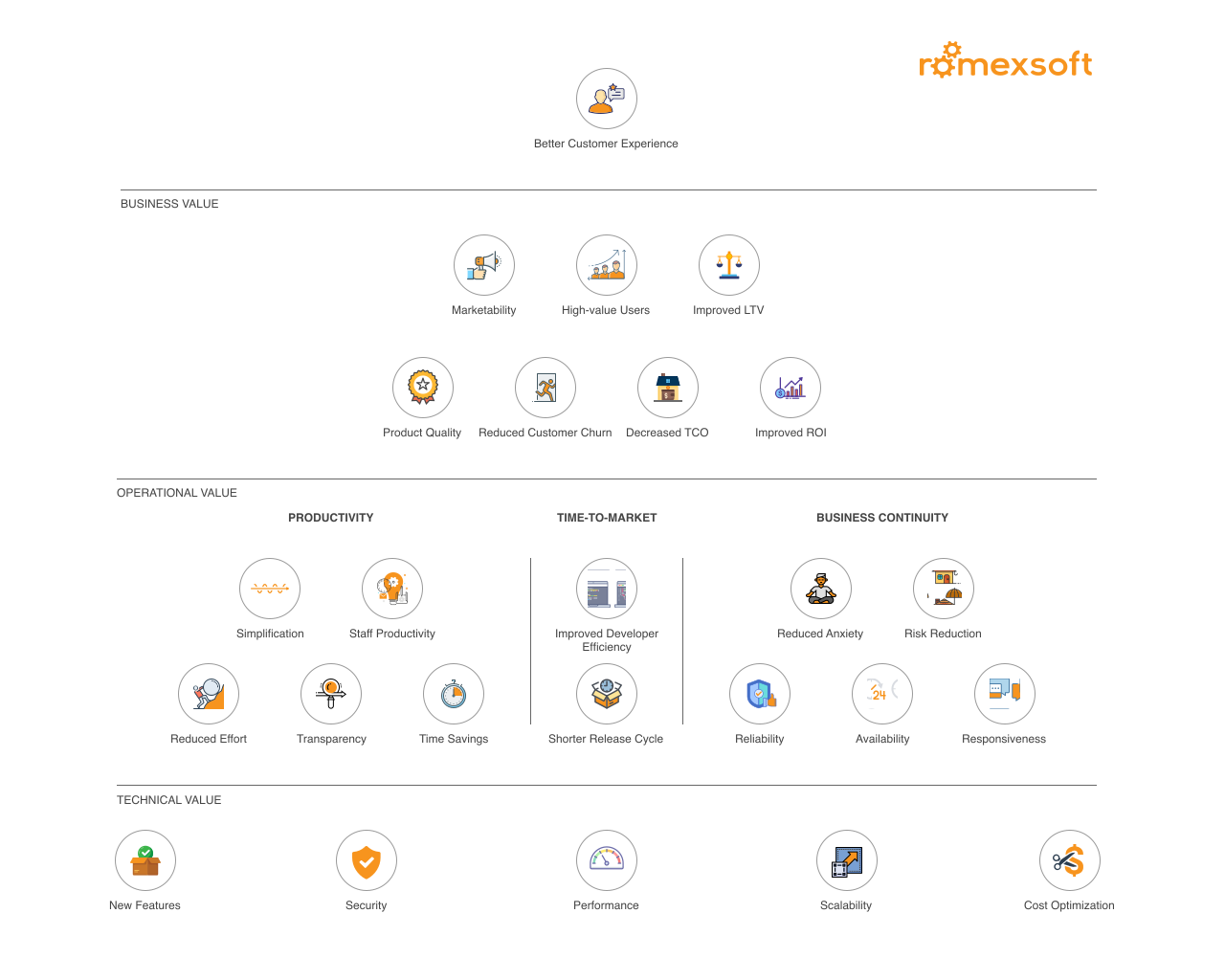
To support this process, our professionals at Romexsoft took their years of experience and compiled the App Modernization Value Pyramid into a graphic model. The model showcases areas of app modernization values, with more objective items being at the base of the pyramid, and the more subjective items situated at the top.
To draw more familiar parallels, the pyramid follows the famous Maslow hierarchy of needs framework, applying it to Application Modernization principles.
Looking at the base level we can see the technical values of application modernization – the tangible items that can be measured and compared before and after the implementation of the modernization project to gauge improvement.
Above the base level lie the operational values: productivity, time-to-market, and business continuity. These elements make doing business easier by reducing the time and effort required to be spent in order to complete a task.
Following the pyramid further up we find the business value level. These metrics reflect the state of your business and add value to it when improved.
You can clearly see that we’ve put better customer experience on top of the pyramid. We did so because here at Romexsoft we believe that customer is king, and that no matter how long the list of values a project may produce, customer satisfaction remains at the top of our priorities.
You can either choose to work on all three areas of App Modernization we have indicated, or focus on just one or two of them, but always remember to go through the value levels of the pyramid from the bottom up.
Planning and Roadmapping
After going through the vital preparation stage during the planning phase, plot the app modernization information you gathered on your application’s roadmap timeline. The timeline should usually include project goals, tasks, assignments, and fixed start and end dates. Project roadmaps can align with your project timeline either according to phases of the project lifecycle (e.g., initiation, planning, implementation, and closing), or the entire project’s timeframe.
The most common ways to use the modernization project roadmap are to communicate with the project team about tasks to do and goals to meet, to make prioritization decisions, and to measure progress across objectives. The details on your modernization roadmap can either be more overarching or more granular – it depends on who you are presenting the roadmap to, and what kind of information you need to communicate to them.
Some project managers create their roadmaps with spreadsheets or presentation tools. An Excel or PowerPoint template can be a convenient starting point for visualizing early plans, but once your work becomes more elaborate as you add details to it, static documentation can become pretty hard to format and update in real time.
Project management software and purpose-built roadmapping tools should fulfill most of your potential project road map requirements. With those kinds of tools, you can enter your project’s details once, and then tailor the different display versions to suit the needs of different audiences.
If you decide to build your roadmap using specialized software, look for any convenient tool that will allow you to display and customize the following elements:
View project timelines
Set goals and success metrics
Track activity across pillars of work
Display project phases, milestones, and dependencies
Break down tasks with assignees and due dates.
Select Strategy
It’s important to understand what your project drivers are, to communicate those drivers to your team and stakeholders, and to correctly prioritize them (preferably according to time-to-value). Each additional driver potentially adds time, costs, scope, and risks to your already complicated migration. A good modernization strategy would be to set the right realistic expectations at the early stages of the project. This approach enables organizations to reduce technical debt and eventually operate at scale, and it opens up opportunities for trying different modernization approaches.
Another one of the main keys to modernization success is alignment of requirements across stakeholders and teams. Performing IT modernization often requires collaboration between different teams across the organization. These teams might have individual priorities and/or other projects that might have already commenced. If these teams are working across different timelines and with different priorities, it makes it more challenging to agree on a coherent modernization plan.
Define Scope
We recommend investing some time in thoroughly defining the scope of your project by working your way backwards from your target modernization business outcomes. The scope might change as you work on the project, because large-scale modernization comes with many unknowns. These unknowns could come in the form of systems that have become part of the archeology of the environment with little to no understanding of their relevance, or production incidents that cause delays and changes to the plans you have made. The solution would be to have room for flexibility and develop backup plans to avoid stalling the project when unforeseen circumstances occur.
Modernization Execution and Operations
After you’ve taken the time to understand your SaaS business goals, and identified the SaaS stakeholder hassles that need to be resolved, prioritize these two tasks for your modernization project according to the time-to-value principles. Time-to-value can be simply explained as whatever task you do first will bring value quicker.
Based on our experience, using a time-to-value approach works pretty well for SaaS companies. Putting an emphasis on time-to-value in your modernization project will help you reach its objectives faster. This, in turn, will bring in positive ROI and strengthen customer relationships, both of which are, as we have already established, important metrics for SaaS executives.
A well designed app modernization roadmap is aligned with:
business goals
stakeholder needs
current IT assets (apps, infrastructures, data sources, environments)
available resources (budgets, information, development capacity)
technical expertise and hands-on experience
established engineering practices
ongoing business operations
organizational timelines.
To turn your outdated app into a modern app, you need to follow the legacy application modernization process, which usually includes the following activities:
bug fixing
tech debt removal
IT spending optimization
performance improvements
new functionality implementation
latest security standards implementation
development & deployment cycles improvements.
Common Pitfalls In Modernization Roadmap Creation and How to Solve Them
These are the key points from our personal experience of managing long-term projects related to software modernization. Keep them in mind while creating your own application modernization plan.
Poorly Defined Business Needs
Convincing business executives to spend money on app modernization with seemingly intangible benefits is a fundamental challenge of many application owners. After all, how do you explain that you want to re-do an already working application to someone who’s not an IT person?
To solve this communication problem, explain your case in business terms. Try to minimize the amount of specific technical terms when trying to get your stakeholders’ buy-in, and focus on showing measurable business value of every update, change, and feature that app modernization can bring. Make sure to clearly list what resources you will need to accomplish your modernization project and how you will use them, as well as provide a detailed project timeline.
Providing specificity in familiar terms in such a way has been proven to be a major aid in selling the idea of app modernization to business executives. We have seen many cases of modernization projects failing because the stakeholders lacked a clear understanding of why they even need to invest in an often complex and long-term modernization project in the first place. Thus, a solidly presented case on how modernization brings business value can be key to your project’s success.
Timeline-Based Roadmaps
The old-school way of roadmapping follows a timeline format. You can tell it’s still popular by typing ‘product roadmap’ in your browser and seeing the resulting mess in the image section. We analyzed what’s wrong with the timeline format, and this is our insight:
If we deconstruct a timeline roadmap into its basic components, it turns out to be just a simple chart with time on the x-axis and things to do on the y-axis. Which seems self-explanatory at first, but the further that timeline stretches, the more things you have to keep track of.
Committing to a time-based roadmap means you won’t be able to adapt as easily. This can get in the way of meeting the expectations you’ve set in your organization. To avoid that, you need to have a plan that allows you to make ongoing changes if needed, and adjust your modernization priorities according to business needs.
You can achieve this by aligning your modernization plan with business priorities and the overall strategy of the organization/product. It is also necessary to communicate the direction, focus, and goals to stakeholders and team members involved in your modernization project.
We aren’t the first ones to reach these conclusions. Our point of view closely overlaps with the thoughts of Janna Bastow. If you’re interested in how to deal with timeline format traps in your roadmap creation we definitely recommend checking out her X thread about this specific topic in detail.
Old and Outdated Application Dependencies
It’s safe to say that almost every application will encounter the problem of technical debt in its lifetime. Technical debt is an impairment to an application’s workflow that negatively impacts business agility due to old and outdated modules. These modules could’ve been written 5 or 10 years ago and simply have become outdated; or they could be having issues with communication with newer additions to the app. In any case, resolving technical debt often shows up as a task on every IT team’s agenda. At the same time, this task is notorious for frequently being put off for a later time when prioritizing.
The rip-and-replace approach to dealing with outdated dependencies may seem like an attractive solution to the issue described above. However, most of the time removing and replacing a fundamental module can influence the way the whole application works, which, in turn, can negatively impact or even stall business activity. So, rather than rewriting a whole application from scratch, have your IT team work on their skills of deconstructing the code to its bare fundamentals and updating functions one at a time.
Automation In The Development Process
Make a point to automate as many processes as you can when you are modernizing at a large scale if you want to do it within a reasonable period of time. To achieve efficient automation, make sure that every coder and creator in your development team is following a repeatable pattern to streamline production.
Another suggestion would be to identify and eradicate manual processes and tools continuously, because, as your infrastructure costs go up, your operations costs increase accordingly. If you can constantly improve the application environment, you can increase the elasticity of your labor pool from the SRE team, and move more workforce to the development team – all because you will have a more stable and less resource-intensive environment. This is the case because when your operation costs go down, you can invest more resources into building-up the capability of your organization, which, in turn, will bring innovation and agility.
On the other hand, missing out on complete automation can cause budget wasting due to automation not being implemented properly, or being implemented at the wrong time (for example during change implementation).
Revisioning The Governance Processes
Modernization rarely means just technological improvements. Modernization requires your organization’s processes, structure and skills to adapt. The organizational culture needs to grow in order to adopt the DevOps and cloud native practices and their development, build, deployment, and operational benefits.
For example, it’s hard to achieve efficient automation that we described above if you don’t revisit your whole governance process. We recommend centering the updates of your governance processes and frameworks, as well as of configuration management, around development automation and CI/CD.
It usually takes time to figure out how to alter your company’s core processes and policies in a way that will allow the new technologies introduced by IT modernization projects to work properly. It’s a good idea to reserve some time for thinking about possibilities for reorganization before developing the software modernization roadmap for your upcoming project.
Serhiy is the CEO of Romexsoft and a Cloud and Solutions Architect who leads AWS solution design for client projects. He supports complex BFSI initiatives and ensures delivery aligns with timelines, budgets, and quality standards.
Frequently Asked Questions
What indicators signal the need to change the roadmap for modernization?
Common signs that a roadmap needs updating include changes in business priorities, repeated delivery delays, rising operational or security risk, or when expected value is not being realised. Significant dependency issues or integration blockers uncovered during execution are also a clear signal, along with changes in team capacity, skills, or underlying technology constraints.
What exactly is a modernization roadmap and why should I care about it?
A software modernization roadmap is essentially a strategic blueprint that lays out the steps and processes for updating and enhancing an existing software application. It's a big deal because it provides a clear direction and timeline for your modernization project, ensuring everyone involved knows what's happening and why.
How can a roadmap of the modernization help me hit my business goals?
A roadmap can be a powerful tool for achieving your business goals. It provides a clear vision and direction for your modernization project, helping you set explicit goals and priorities. It also facilitates effective communication among your team members and sets realistic expectations for your project's stakeholders and team members.
Is there a difference between a project roadmap and a project plan?
Yes, definitely. Project plans are used to plan and manage and control project execution, while a project roadmap serves as a big picture of the project life cycle.
Project plans usually serve as internal tools for teams because of how much detail they provide. Managers use project plans to assign responsibilities, track activities and resources, and overlook daily progress across teams. A project roadmap is considered vital in project management because it is a tactical list of objectives that identifies your project’s main goals and general stages.
You can use the bigger-picture view of the roadmap to efficiently create a detailed project plan that defines specific resources, budgets, and activities required to complete the project. This is why we recommend developing your project roadmap before compiling the project plan.
We use cookies to personalize content and ads, to provide social media features, and to inspect our traffic.
To learn more please check the following link privacy.