Published: November 17, 2025;
29 min read
| Updated: November 18, 2025

Like many organizations, yours may be facing challenges when seeking secure, scalable, and high-performing search and analytics solutions. Indeed, the pursuit of making the most of the available data is often hindered by operational complexities. Be it data security or scalability issues, this is where Amazon OpenSearch Service comes into play.
Should you be new to Amazon OpenSearch Service or quite a confident user already, this all-encompassing article will guide you in the intricacies of data-driven approach and analytics. The article will give you a thorough overview on:

Table of Contents
Basically, search is all about efficiently extracting insights from data. There’s also a trend combining text-based and natural language search, which you can read about further in the article. As OpenSearch serves as a powerful search engine with robust capabilities, particularly in log analytics, we are going to devote the article to innovations when it comes to extracting valuable insights from log data.
Table of Contents
In order to ensure seamless business operations, IT teams are to process an unprecedented volume of information, including log data, security data, and application performance data.
Amazon OpenSearch, is a managed service offered by AWS that is based on the OpenSearch project. While Amazon OpenSearch Service includes additional features and management tools. It stands out as a robust and widely utilized solution for handling these demands, there is untapped potential for numerous organizations to extract even greater value from it.
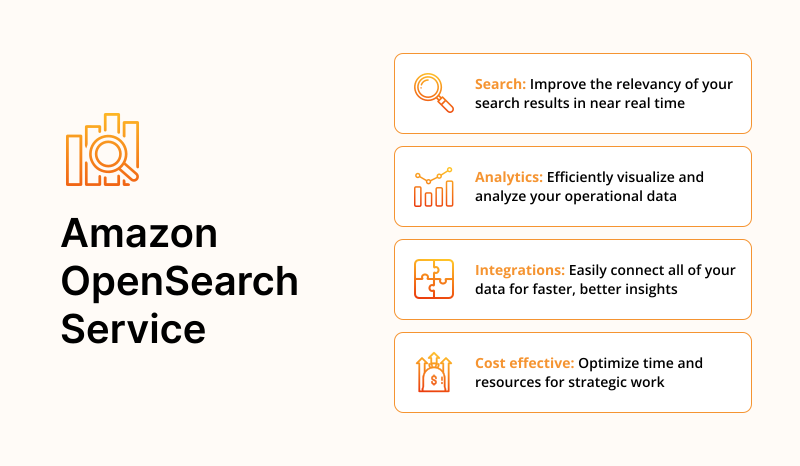
Amazon continues to expand the AI-driven search capabilities in OpenSearch, building on the Neural Search plugin. Recent enhancements focus on improved relevance, efficiency, and flexibility through hybrid search, fine-tuned model hosting, sparse vector retrieval, and multimodal search. These features give teams more powerful search options without additional infrastructure or complex pipelines.
OpenSearch Service also offers a serverless option for running search and analytics workloads in order to tackle all your infrastructure concerns. This serverless feature is perfect for handling sporadic or unpredictable workloads which will spare you the need to consider cluster sizing, monitoring, or fine-tuning.
The service tracks vital metrics, such as CPU usage, disk capacity, memory, and shard status. Should these thresholds be exceeded, the system automatically adjusts capacity without requiring any manual intervention. In OpenSearch Serverless, storage and compute function independently, allowing separate scaling, which prevents a number of possible challenges.
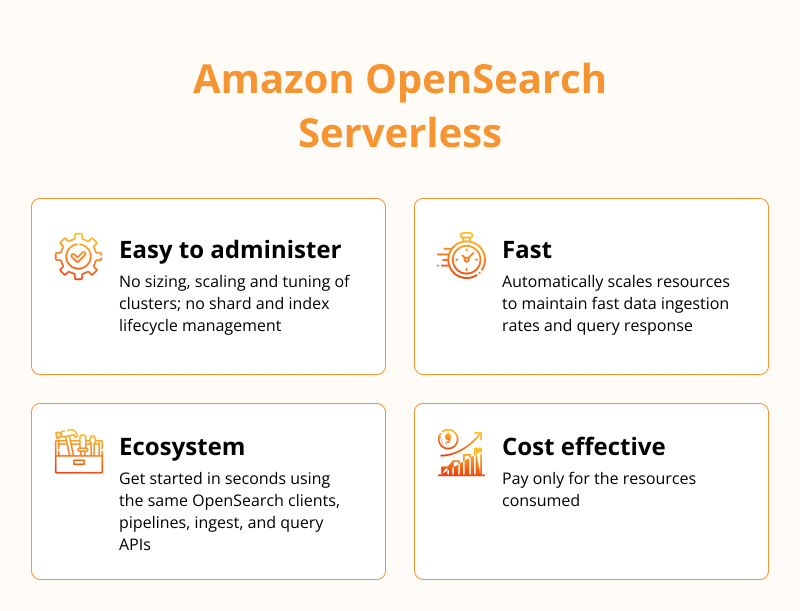
As of now, though, OpenSearch Serverless does not provide support for advanced OpenSearch Service functionalities, such as alerting, anomaly detection, and k-NN. If those are on your list of priorities, you can leverage managed clusters to access them until they are integrated into the serverless option.
For situations demanding precise cluster configuration or tailored adjustments, opting for provisioned clusters proves commonsensical. Managed clusters offer the flexibility to select your desired instances and versions, offering you enhanced control over configurations like refresh intervals or data-sharding strategies. These features can be crucially important for use cases that deviate from the standard patterns that OpenSearch Serverless is able to address.
As a distributed, community-driven, Apache 2.0-licensed, entirely open-source search and analytics suite, OpenSearch finds utility across a wide spectrum of applications and caters to diverse use cases, excelling in real-time application monitoring, log analytics, and website search. The platform allows exceptional scalability, ensuring rapid access and responses to vast data volumes.
Integrated with OpenSearch Dashboards, it empowers effortless data exploration with a set of visualization tools. Since OpenSearch runs on the Apache Lucene search library, it has a rich array of search and analytics capabilities, including k-nearest neighbors (KNN) search, SQL functionality, Anomaly Detection, Machine Learning Commons, Trace Analytics, and comprehensive full-text search to name just a few.
On the other hand, AWS managed OpenSearch is a closely aligned managed offering linked to the open-source search and analytics framework, formerly recognized as Elasticsearch and now known as OpenSearch. Further on you can examine how exactly Amazon OpenSearch is connected to OpenSearch.
Having taken those points into account, one concludes that AWS managed OpenSearch is a managed solution built upon the open-source OpenSearch project. The Service streamlines the deployment, operation, and scaling of OpenSearch clusters, presenting an appealing option for organizations seeking the benefits of OpenSearch without the associated operational complexities. While OpenSearch forms the open-source foundation, the OpenSearch solution enriches the platform with AWS-specific enhancements, integration, and proficient management.
Simplifying AWS cloud operations
Amazon OpenSearch Service seamlessly integrates with AWS services and offers the flexibility to choose between open-source engines like OpenSearch and ALv2 Elasticsearch. Embracing OpenSearch Service eliminates the complexities associated with managing OpenSearch and legacy Elasticsearch clusters in the AWS Cloud since it takes charge of administrative tasks: from provisioning infrastructure to software installation.
A managed solution for data power
As a managed platform, OpenSearch Service streamlines various data-centric tasks, such as website searches, interactive log analysis, and real-time application monitoring. Built on the open-source OpenSearch platform, it empowers you to explore, visualize, and analyze vast amounts of unstructured data, scaling up to petabytes of volume.
Advanced analytics suite
OpenSearch Service is your analytics suite for interactive log analytics, real-time application monitoring, and web search, featuring the latest OpenSearch versions and support for 19 Elasticsearch versions ranging from 1.5 to 7.10. It also boasts visualization capabilities through OpenSearch Dashboards and Kibana versions from 1.5 to 7.10.
Hassle-free resource provisioning
The Service not only provisions resources for your OpenSearch cluster but also automates the detection and replacement of failed nodes, alleviating the burdens of self-managed infrastructures. As to scaling your cluster, a single API call or a few clicks in the console suffice to do the job.
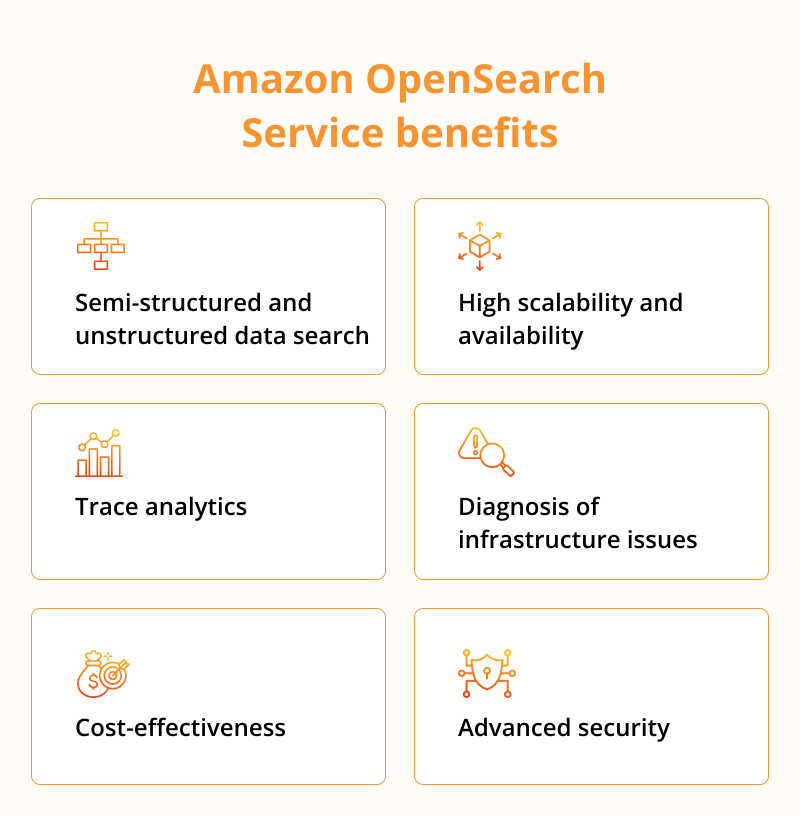
This chapter delves deep into the heart of Amazon OpenSearch, uncovering the myriad advantages it brings to the table. You’ll discover how this powerful tool empowers organizations to make data-driven decisions, accelerate innovation, and ultimately gain a competitive edge in today’s data-centric landscape.
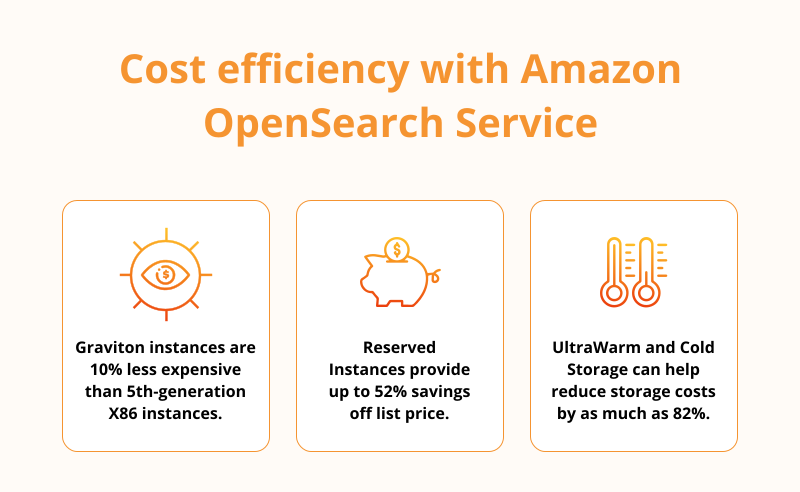
Typically for AWS products, OpenSearch Service follows a pay-as-you-go model: no minimal fee or upfront costs incurred. There are three categories for OpenSearch Service pricing, and you can explore more detailed information regarding OpenSearch Service pricing further on.
Instance hours
The pricing structure is influenced by the specific compute instance type and number that you choose to use in your data cluster.
Storage
Costs are incurred based on the Amazon Elastic Block Store (Amazon EBS) storage type and the capacity you need for your information volume. If you opt for Provisioned IOPS (SSD) storage, you will incur charges for the storage itself as well as the throughput you provision; you will not be billed for the I/Os you actually use, though.
AWS data transfer charges
For data transferred in and out of OpenSearch Service, you are subject to standard AWS data transfer fees. That being said, you will not be billed for data transfer between nodes within your OpenSearch Service domain.
Should you require a more detailed overview of the pricing tiers and options, do not hesitate to visit Amazon’s website.
Let us explore the challenges faced by data engineers and the solutions offered by Romexsoft’s specialists, which are based on data integration in OpenSearch.
Integrating data into OpenSearch presents its own set of obstacles: engineers must determine the best method for collecting data. Subsequently, they need to ensure data durability by storing it in S3 as well as implement buffering mechanisms to handle scenarios where downstream systems are unavailable or encounter impedance mismatches.
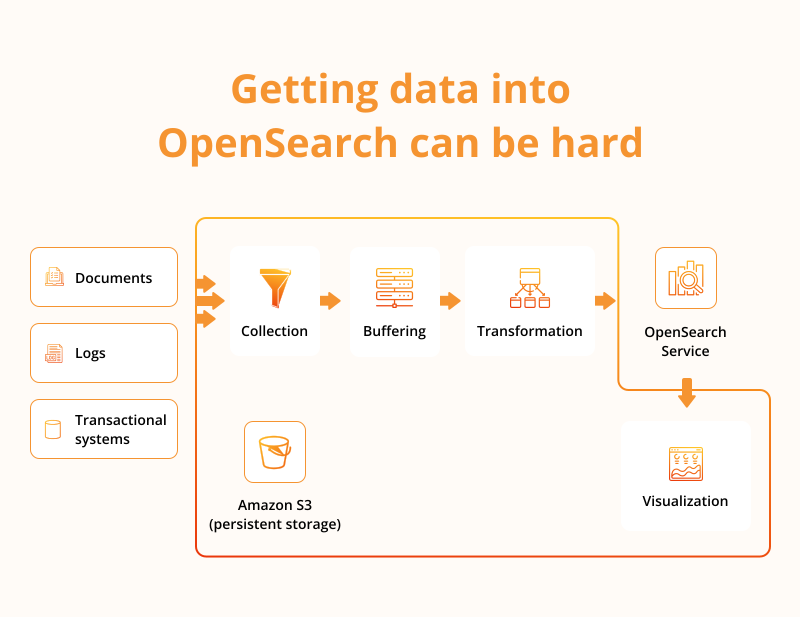
Additionally, the need to transform the data may involve tasks like removing duplicates or conditionally routing data to different clusters. These transformations add complexity, often requiring custom code to be written. Furthermore, any changes in log data or documents necessitate updating this code, making the process rather cumbersome.
Amazon Ingestion is meant to address these challenges head-on. The service simplifies the entire data integration process, handling all the heavy lifting effortlessly in order to effortlessly send your logs or documents to the endpoint with the use of connectors to S3 and Kafka, among other sources.
Delving deeper into the Ingestion service, it introduces the concept of sources, which connect to different transactional systems or handle log data. Various processors, including those for data enrichment and duplicate removal, can be seamlessly integrated. The synchronization point typically revolves around the Amazon OpenSearch Service.
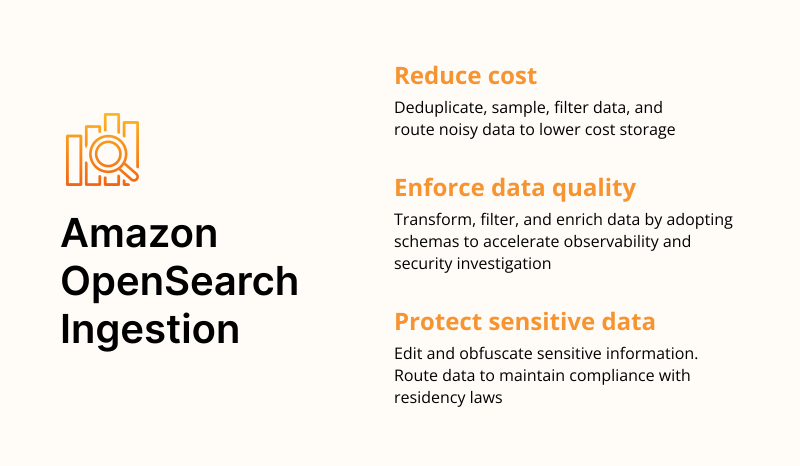
Within Amazon Ingestion, one can configure different processors to transform your data without the need for coding so as to seamlessly transmit the data into an OpenSearch cluster. As far as user experience is concerned, the serverless service dynamically adjusts to traffic demands without the need for manual scaling or sizing.
The next are the most common obstacles that OpenSearch-associated personnel struggle with, along with how to tackle them effectively with the help of the most recent AWS features.
Another challenge frequently mentioned by engineers is integrating search functionality into applications built on platforms like DynamoDB. When incorporating search capabilities into DynamoDB-based applications, transitioning data to a search platform like OpenSearch poses a significant hurdle. Typically, data engineers resort to developing pipelines, often employing Lambda functions or running processes on EC2 instances utilizing streams. This process can be daunting and complex for users seeking to seamlessly integrate search functionality into their DynamoDB-powered applications.
At the close of 2023, a Zero-ETL integration with DynamoDB was unveiled, intended to simplify the synchronization of DynamoDB tables with OpenSearch indices. This integration can be easily accessed through the Dynamo console, allowing users to specify the index they wish to utilize for OpenSearch upon table creation. With this integration, the Ingestion service takes care of all the complex tasks, which ensures seamless data transfer from DynamoDB to OpenSearch and keeps it continuously updated.
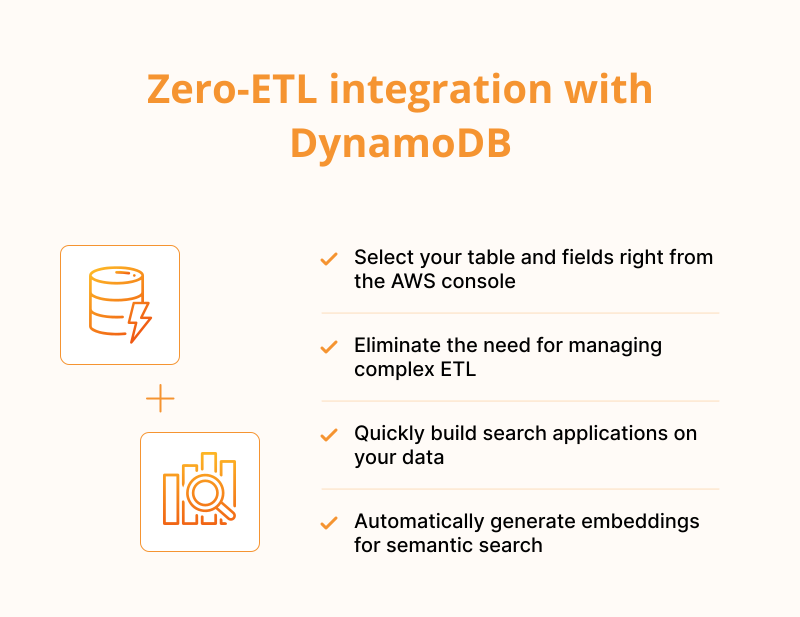
Reflecting on the journey of data engineers dealing with data integration into OpenSearch, these innovations, including the Ingestion service and Zero-ETL integration with DynamoDB, have significantly eased the process. Data engineers can now focus on more meaningful tasks without being burdened by the intricacies of data synchronization.
AI and ML utilize a process of converting information into vectors, which are rows of numbers representing dimensions, – often numbering in the thousands, form the model’s interpretation of the document’s content. During a search, the system seeks the closest match in this high-dimensional space to retrieve the most relevant objects corresponding to the query.
This methodology is applied across various data types, including images, audio, logs, and text documents. Documents are inputted into the model, which then translates them into vectors. These vectors can be stored in a vector database, with the Amazon OpenSearch Service and its vector engine serving as popular choices for vector storage solutions. This approach allows models to effectively process and analyze diverse forms of data, facilitating accurate and relevant search results for users.
If we simplify the concept of a basic chat flow, a user initiates a question that gets processed by a language understanding model (LLM), converting it into a vector. This vector is then sent to OpenSearch, which retrieves a set of results that are translated back into human language and returned to the user.
However, real-world applications of gen AI are typically more complex. To create a seamless user experience, multiple stages of analysis are often required, including reasoning and chain of reasoning. Achieving this involves building an application middleware, which can be facilitated by tools like LangChain, LlamaIndex, or Haystack. Each step in this middleware workflow may involve interactions with one or more models, as well as vector databases. Despite the complexity, investing effort into building such middleware is necessary to ensure a robust and comprehensive gen AI application.
Neural Search in OpenSearch enables applications to interact seamlessly with OpenSearch using familiar APIs. Within OpenSearch, the indexing and search pipelines have been decomposed to streamline the process. When a document is sent to OpenSearch, it enters the Ingest pipeline. For instance, if the document is an image, it can be passed to a model to generate embeddings, which are then stored along with other metadata.
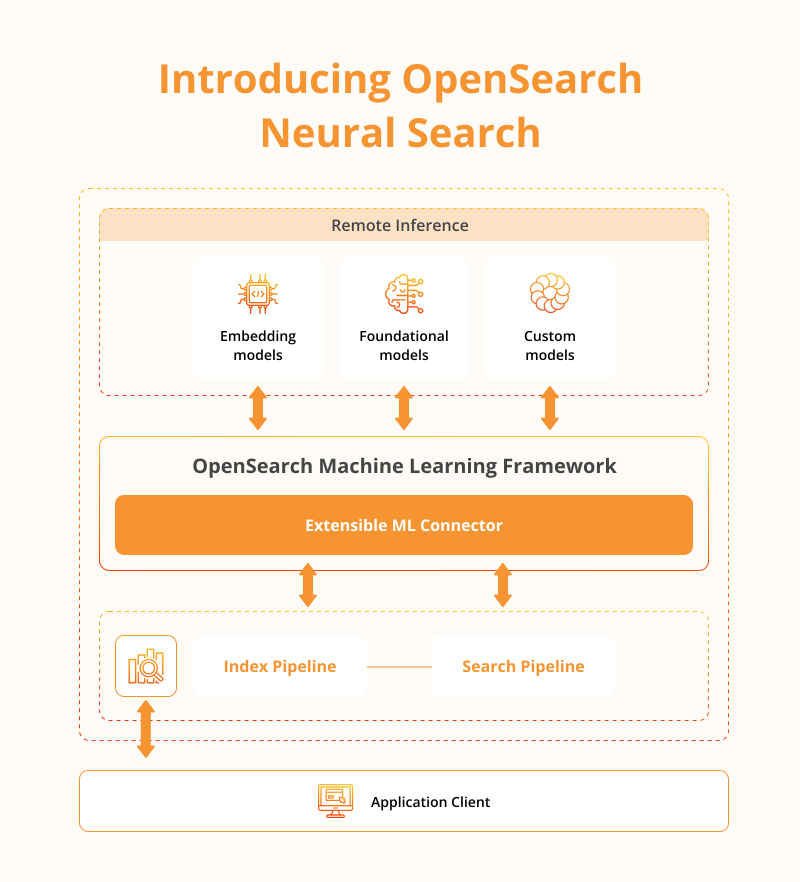
Similarly, in the search pipeline, multiple stages can be configured. For example, the pipeline may begin with a lexical search followed by semantic search results from a model. These results can be compared and assigned a composite score. Additional stages might involve personalized ranking based on user preferences and even result summarization. Importantly, all of this functionality can be achieved without the need to develop middleware, using only OpenSearch APIs for seamless integration.
This approach also simplifies the process of testing out new ideas and innovations. With the constant emergence of new models, having a stable application stack provides a reliable foundation for experimentation. The goal is to empower users to explore and implement new concepts effortlessly, fostering a culture of innovation and continuous improvement.
OpenSearch serves as a widely embraced tool for log analytics and observability, attracting a significant user base due to its robust capabilities. Its distributed nature and ability to handle substantial data streams while delivering rapid query responses make it particularly suitable for such tasks.
For developers and DevOps engineers, leveraging OpenSearch Service entails mastering query writing for forensic analysis, creating customized dashboards, configuring alerts, and manually correlating disparate data sources to identify relevant issues. At the same time, it is Security Analytics where additional tooling matters most to obtain insights effectively.
In scenarios where individuals bear the responsibility of addressing issues promptly, having efficient tools becomes paramount. Minimizing downtime not only reduces stress but also facilitates swift problem identification, forensic analysis, and root cause determination, enabling users to resume normal activities without undue delay.
When managing system operations, the necessity for robust tooling and minimizing downtime cannot be overstated. The tools at one’s disposal during critical moments, such as resolving issues in the middle of the night, play a pivotal role in maintaining system integrity and user satisfaction. Every moment of system downtime not only translates to potential revenue loss but also incurs stress and frustration for those tasked with resolving the issue. Effective tools can streamline the process of problem identification, analysis, and resolution.
In order to address these challenges, the AWS team introduced observability features to OpenSearch a few years back. These additions include built-in anomaly detection and alert systems. OpenSearch also offers extensive support for open telemetry data. With its help, users can conduct tracing and visualize spans and service maps, which proves invaluable in identifying and isolating issues within complex environments. Additionally, OpenSearch incorporates features like log pattern analysis, tailing, and surrounding, which all add up to further streamlining the troubleshooting process.
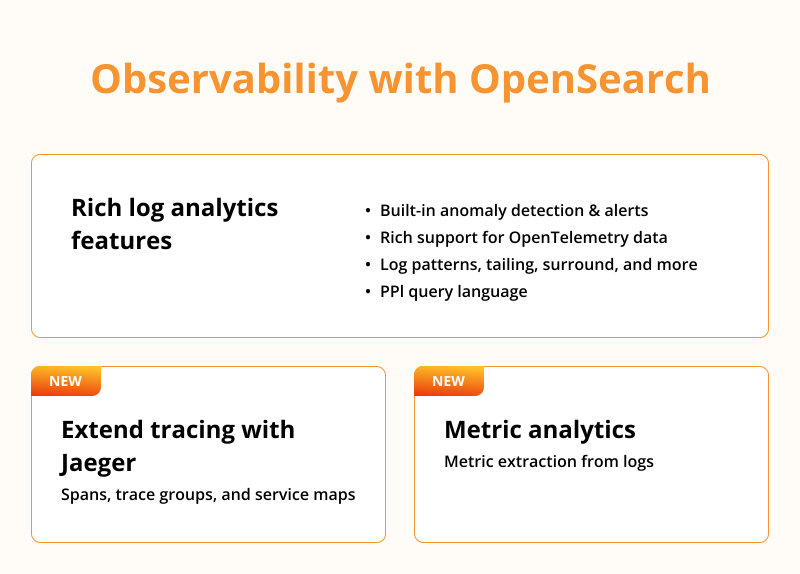
Another novelty feature in question, commonly known as PPL, was specifically tailored for efficient data discovery and exploration. PPL allows for a logical flow of operations so as to seamlessly sort, group, and filter data. This all makes exploration tasks more intuitive compared to traditional methods like SQL or OpenSearch DSL. Recently, Piped Processing Language has been expanded to include full visualization support for Jaeger, a widely used tracing format. This includes features such as span visualization, trace groups, and service maps. Another innovation is the automated extraction of metrics from logs, ensuring they are correlated with the broader system for comprehensive analysis.
Performing search and analytics is often obstructed by the complexity of formulating queries and extracting meaningful insights from data. Traditional query languages like SQL or OpenSearch DSL can be cumbersome and require a steep learning curve, especially for users without a technical background. Many engineers find interpreting and visualizing large volumes of data to derive actionable insights rather time-consuming.
Another thing is that users may face difficulties in navigating complex data structures and understanding the relationships between different data points. Without intuitive tools and interfaces, the process of exploring and analyzing data can be inefficient. Inconsistent data formats and disparate sources further compound the challenges.
A step towards tackling those challenges has been made with the OpenSearch Assistant Toolkit. It enables users to write queries using natural language in order to simplify the process of formulating complex search queries. Once a query is executed, the Assistant automatically summarizes the results, so the insight generation becomes smooth and quick.
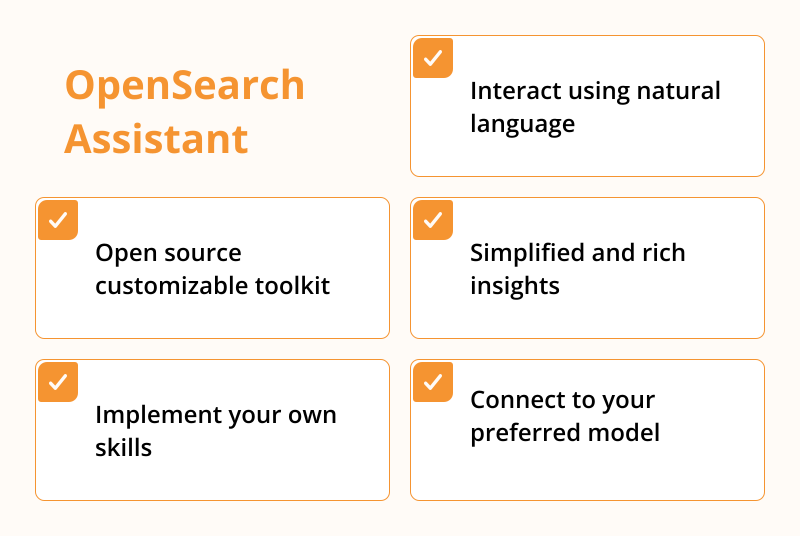
Speaking of the near future, the Toolkit is certain to grow new capabilities, such as creating visualizations or setting alerts based on specified thresholds; these features aim to streamline the problem-solving process and enhance user productivity. The toolkit is currently available as open source and will be integrated into the OpenSearch Service in the future to offer users a customizable solution for their search and analytics needs.
One can now explore the functionality of the OpenSearch Assistant Toolkit at observability.playground.OpenSearch.org. The site provides an interactive environment to experiment with querying data and experiencing the summarization feature firsthand. The toolkit’s architecture leverages Anthropic Claude in the backend, which ensures robust reasoning logic for efficient query processing.
It has always been duly noted that utilizing OpenSearch Service for Security Analytics can be challenging. Unlike observability and monitoring tasks that involve aggregations, such as checking if error rates exceed certain thresholds over a period, Security Analytics demands examining each log line against a threat database. This meticulous process underscores the complexity of security analysis compared to other monitoring activities.
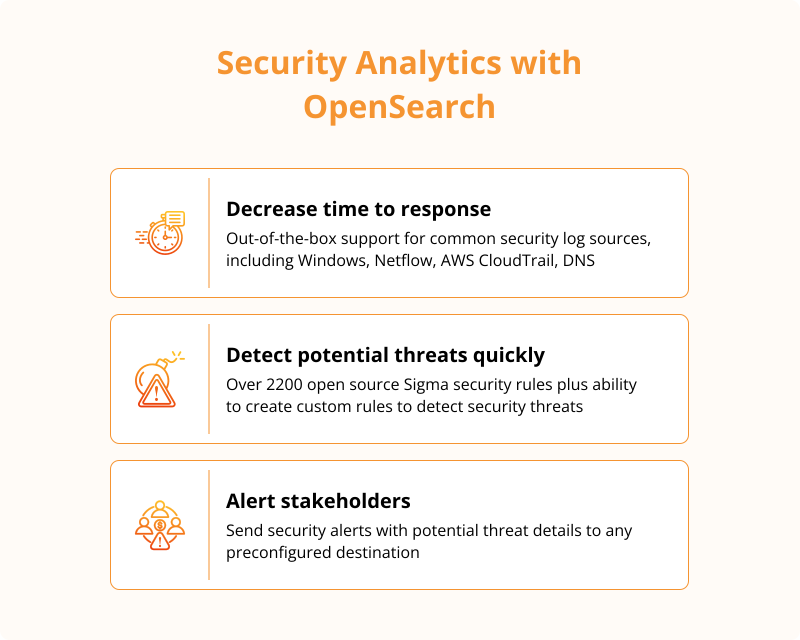
In response to the poignant needs, Security Analytics was introduced last year, integrating alerting and a rules engine capable of analyzing logs against both custom and 2,200 Sigma rules upon ingestion. Its capabilities detect issues in every log line and employ a correlation engine to closely associate threats across different entities, such as hosts and requesters. The correlation engine automatically constructs a graph to visualize potential threat relationships without manual configuration.
One of the recurrent challenges faced by users of Amazon OpenSearch pertains to ensuring the platform’s reliability, particularly when nodes or entire Availability Zones encounter downtime. Although in systems like the service data and operations are distributed across multiple nodes and AZs for fault tolerance and scalability, when a node fails or an entire AZ experiences downtime, it can disrupt the system’s operation and compromise its reliability.
Achieving a 99.99% uptime, which is often a requirement for critical applications and services, becomes especially challenging in such scenarios. Downtime, even if brief, can lead to service disruptions, which affect user experience and potentially cause financial or reputational damage.
As of early 2023, Amazon unveiled Multi-AZ with standby, a groundbreaking enhancement to bolster reliability. This innovative feature guarantees 99.99% availability by significantly reducing data transfer during AZ or node failures. By incorporating a standby AZ, the system seamlessly transitions to ensure uninterrupted operation. This capability is especially advantageous for latency-sensitive applications, as it maintains high availability without any downtime, even during unexpected events.
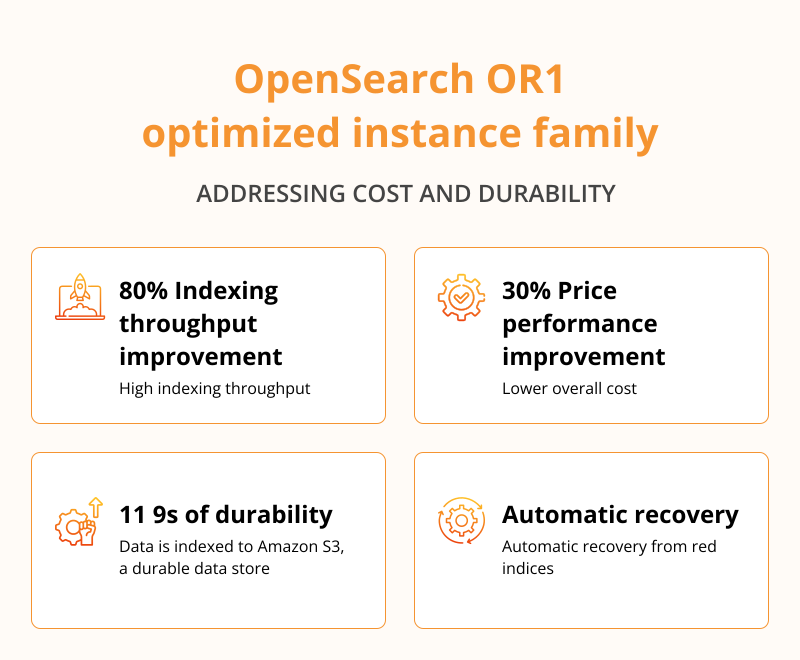
One more 2023 Amazon OpenSearch announcement concerns their optimized instance family. This instance type offers an 80% increase in throughput and a 30% enhancement in price performance. If your workload involves heavy indexing or writing, you will enjoy the advantages of higher throughput and reduced costs. Additionally, these instances boast high durability, comparable to S3, as they are now supported by S3.
So as to ensure efficient data storage, processing, and retrieval in large-scale environments of distributed systems like OpenSearch, the following two become critical.
Firstly, what allows for better performance and scalability is sharding (dividing a large dataset into smaller parts called shards), with its function of distributing the data and workload across multiple nodes.
The latter, in turn, have to be managed. Monitoring of individual nodes, with roles from data storage and indexing to coordinating operations within the cluster, ensures that the cluster operates smoothly, with adequate resources allocated to handle incoming requests and data processing tasks.
Unfortunately, handling both of these vital components of OpenSearch manually can be complex, especially as the dataset grows or changes in structure.
For this reason, OpenSearch launched Serverless functionality, which enables automatic scaling based on traffic without the need for sharding or node management. Simply send data to the Serverless endpoint, and it handles scaling operations seamlessly.
Examining the Serverless architecture, storage and compute have been decoupled, as well as indexing and search. Indexing occurs on dedicated nodes, with data stored in S3, while search operations are handled by separate nodes, this decision enables independent scalability.
Huge amounts of data drive log analytics, and businesses seek to prevent suspicious actions, predict imminent critical system occurrences, and accelerate in-depth root cause analysis. The DevOps teams are under pressure to achieve observability with apps’ log, trace, and metric data, all the while focusing on root cause analysis and anomaly detection. This challenge further extends to developers, who are tasked with crafting customized integrations, which entails time-consuming implementation and troubleshooting.
Moving on to customers, the management of open-source search engines like Elasticsearch and OpenSearch imposes a few responsibilities on them, as well. These encompass cluster administration, capacity sizing, scalability adjustments, optimization, patch application, and hardware oversight.
A search feature in a website or app empowers users to effortlessly locate what they are seeking by simply typing into a search bar.
In terms of websites and blogs, implementing a quality content search is a common necessity. User’s location of articles, posts, or any relevant information on your platform – be it an application, a website, or a data lake catalog – can be facilitated by the solution offered by OpenSearch Service. The solution meets more sophisticated users’ search needs as well, such as natural language search, auto-completion, faceted search, and location-aware search.
E-commerce platforms appreciate OpenSearch Service’s rapid and effective product search delivery, which influences the users’ ability to swiftly find the desired items directly. The shopping experience becomes ultimately satisfying with OpenSearch Service features of auto-suggestions, filters, and faceted search.
It is not only for users that the OpenSearch Service makes a difference: organization employees can use the Service’s features for internal knowledge exploration to quickly access the necessary information within documents, emails, and other company data, thus promoting efficient knowledge discovery. Enterprises also have the option to integrate OpenSearch Service into their internal applications, enabling their employees to swiftly search for documents, reports, and various internal knowledge assets. This implementation expedites the retrieval of information and boosts informed decision-making.
If you are aiming to empower your customers to effortlessly locate their desired information, incorporating fast and scalable full-text search features provided by Amazon OpenSearch will do the trick. The Service facilitates the integration of search functionality into database-backed applications, whereby the search engine mirrors the database content and utilizes machine learning (ML) for ranking, ensuring the delivery of relevant results and elevating the interactivity of customer experiences.
As for those mobile applications that prioritize user engagement in content consumption, such as news apps or social media platforms, OpenSearch Service integration allows users to swiftly uncover relevant content, which encourages user retention. Besides, apps dependent on location data, like mapping or travel apps, can leverage OpenSearch Service to offer geospatial search functionality, simplifying location-based searches. This equips users to explore nearby points of interest, businesses, or specific destinations.
Application owners with distinctive needs embrace OpenSearch Service’s extensive customizability. Whether the requirements involve crafting custom filters, fine-tuning search algorithms, or implementing other specialized functionalities, OpenSearch Service provides the adaptability needed to cater to specific use cases.
Whichever environments you monitor: containers, microservices, or applications, three foundational observability signals are unchangeable: metrics, logs, and traces.
The objective of observability signal collection is to offer a unified experience for DevOps and Site Reliability Engineers, enabling them to pinpoint crucial events and utilize all observability cues to isolate problems within containerized applications and microservices deployed across diverse environments. In order to help teams achieve this, Amazon OpenSearch seamlessly merges both log and trace data analytics into a single, comprehensive solution.
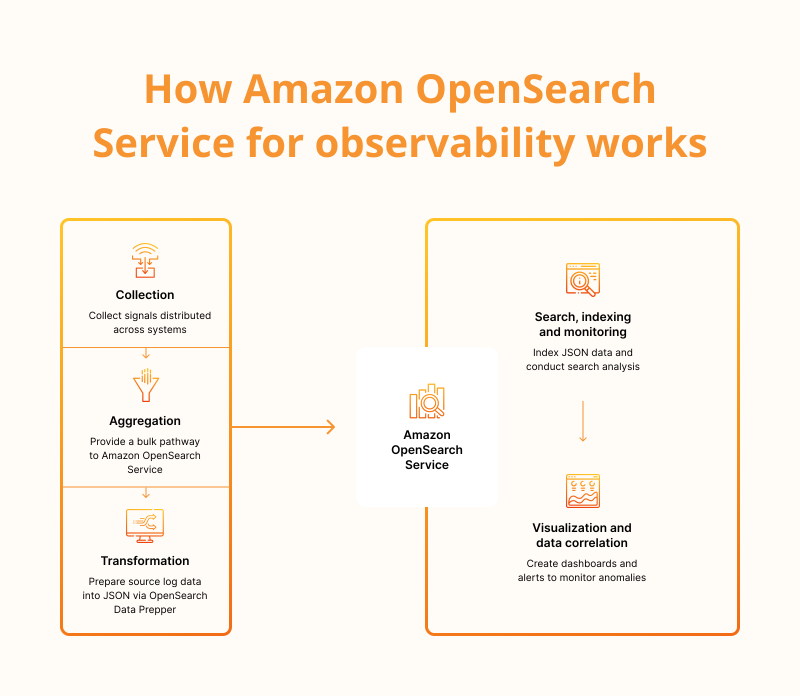
Originating from a multitude of sources, streaming data flows incessantly and encompasses various types: from log files generated by users of an app to telemetry from connected devices or sensors in data centers. Amazon OpenSearch is well-prepared to manage streaming such diverse data.
In dynamic and mixed environments, developers often lack the bandwidth to construct and debug customized integrations for amalgamating data from multiple sources, which can be time-consuming in terms of both implementation and troubleshooting. To accommodate this need, AWS OpenSearch offers built-in integrations with Amazon S3, Amazon Kinesis Data Firehose, Amazon CloudWatch, Amazon DynamoDB, Amazon SageMaker, and AWS Key Management Service (KMS), with an eye on simplifying the process and saving valuable time.
The multitude of logs generated by your applications, devices, and machinery at large scale and high speed often makes it difficult to keep up with and filter the data to identify meaningful insights. One of the challenges lies in maintaining control over diverse log sources and having the capability to anticipate system issues based on error messages.
Regardless of the origin of the log data, yet especially useful for the large information volumes generated by Internet-of-Things (IoT) devices, a cost-effective, secure, scalable, and adaptable solution becomes a pertinent need. Amazon OpenSearch Service consolidates log events into a unified perspective and offers a ready-made environment for initiating the analysis of log patterns thus centralizing the logging of your systems.
Trace analytics, when combined with log data, serve a dual purpose: pinpointing the origin of performance issues and diagnosing their underlying causes. It is worth noting, though, that the task of correlating trace data with log events often involves navigating multiple interfaces. Another complication is that developers are supposed to be qualified specifically in creating visualization to construct monitoring views based on log data.
The good news is that this process can be simplified with Amazon OpenSearch. The latter enables the seamless analysis of both traces and logs through a single interface, streamlining the process of identifying and resolving performance issues within distributed apps. This, in turn, provides developers and DevOps engineers with insights into their application’s performance, allowing them to handle tuning and debugging.
It is reasonable to prioritize log analytics: it plays a pivotal role in safeguarding companies against risks by guaranteeing adherence to security and industry regulations as well as helps to enhance the user experience by detecting performance concerns. Still, the process of collecting application and infrastructure logs from different data origins and preparing them for analysis is rather tedious and time-consuming.
Many businesses now choose open-source log analytics solutions over proprietary software due to their perception of being more cost-effective, secure, and stable. An example of such an open-source log analytics suite, OpenSearch facilitates the ingestion of log data into your Amazon OpenSearch Service domain by employing open-source collectors and aggregators. These logs can originate from various sources, including application and infrastructure logs, security logs, AWS service logs, application trace logs, and application or infrastructure metrics.
For the collection and aggregation of log data, one can use open-source systems like Beats, FluentBit, Fluentd, and Data Prepper. Having been refined, the data can be loaded into Amazon OpenSearch and subsequently visualized and analyzed using OpenSearch Dashboards.
Intending to ensure the robustness of their IT systems, security teams are to sift through a backlog of security alerts. What can be done about this challenge is resorting to a security information event management (SIEM) solution. One of those is AWS OpenSearch Service which simplifies the task for SecOps teams in handling security and event data by consolidating and examining logs across applications and systems, as well as aids with real-time threat detection and incident management.
One practical example of Amazon OpenSearch Service’s features in use refers to rapidly indexing, searching, and visualizing logs sourced from routers, applications, and other devices. This capability facilitates security threat identification and mitigation, the threats including as many different cases as data breaches, unauthorized login attempts, distributed denial of service (DDoS) attacks, and fraudulent activities.
An SIEM function of AWS managed OpenSearch can be further strengthened when incorporated with AWS Security Hub to extend the retention period of findings beyond what Security Hub offers. This integration also fosters the consolidation of findings across multiple administrator accounts and enhances the correlation of Security Hub findings with each other and additional log sources.

Yes, Romexsoft’s specialists can build a cloud-based SIEM with Amazon OpenSearch. Our team designs and implements OpenSearch-based SIEM architectures that give you real-time visibility into security events across your AWS workloads. With centralized log ingestion, built-in threat detection rules, and fast incident investigation, you gain the monitoring and response capabilities needed to protect your applications at scale.
Managed OpenSearch on AWS removes the operational burden of running clusters yourself: no hardware, patching, scaling, or availability management. You get built-in security, automated backups, Multi-AZ resilience, and seamless integrations with AWS services. It’s faster to operate, easier to scale, and typically more cost-efficient than maintaining Elasticsearch infrastructure on your own.
Yes. OpenSearch scales horizontally (more nodes/shards) and vertically (larger instances), and supports data tiers (Hot, UltraWarm, Cold) to keep costs down for long retention. You can set Index State Management (rollover, retention, delete) and use S3-backed features (e.g., snapshots; Serverless stores data in S3) for durable, elastic growth. For spiky or unpredictable loads, OpenSearch Serverless auto-scales ingestion and search. In short: grow ingestion now, age data to cheaper tiers later, without re-architecting.
Yes, Amazon OpenSearch service and its serverless offering are part of AWS’s audited compliance programs, including HIPAA, SOC, PCI-DSS, ISO, and more. However, you as the customer still need to configure your deployment, data handling, access policy, and data geography to align with GDPR or other jurisdictional requirements.